Notorious B.I.G. Death: Facts, Feud, and Unanswered Questions
It’s been more than two decades since a drive-by shooting silenced one of hip-hop’s most commanding voices, yet the questions around that night on March 9, 1997, refuse to fade. Christopher Wallace, known to millions as The Notorious B.I.G., left behind more than just classic albums — he left a murder investigation with more shadows than answers. This article separates what’s verified from what remains speculation.
Born: May 21, 1972 ·
Died: March 9, 1997 ·
Age at death: 24 ·
Number of shots: 4 ·
Murder location: Los Angeles, California ·
Album sales (estimated): over 30 million worldwide
Quick snapshot
- Biggie was shot four times in a drive-by shooting (Britannica (biographical reference))
- He had a Bible and a letter from his mother in his pocket (Britannica (biographical reference))
- Sean Combs paid for the funeral (Britannica (biographical reference))
- The murder remains officially unsolved (Britannica (biographical reference))
- Who ordered the murder
- The exact motive
- Whether there is any connection to Tupac’s murder
- The shooting occurred around 12:47 a.m. on March 9, 1997 (Wikipedia (murder article))
- Tupac Shakur was murdered six months earlier (CAAM (cultural museum))
- The case remains open with the LAPD
- Periodic media investigations continue
- New documentaries keep public interest alive
Here are the key biographical details of Christopher Wallace.
| Attribute | Detail |
|---|---|
| Full name | Christopher George Latore Wallace |
| Stage name | The Notorious B.I.G. / Biggie Smalls |
| Born | May 21, 1972, Brooklyn, New York |
| Died | March 9, 1997, Los Angeles, California |
| Cause of death | Drive-by shooting (gunshot wounds) |
| Number of shots | 4 |
| Murder location | Wilshire Boulevard, Los Angeles |
| Funeral cost | Estimated $40,000, paid by Sean Combs |
| Net worth at death | Estimated $10 million |
How many times was Biggie shot?
Details of the shooting
- Biggie was struck by four bullets during the drive-by shooting (Britannica (biographical reference))
- One bullet hit his chest, one hit his arm, and two hit his leg
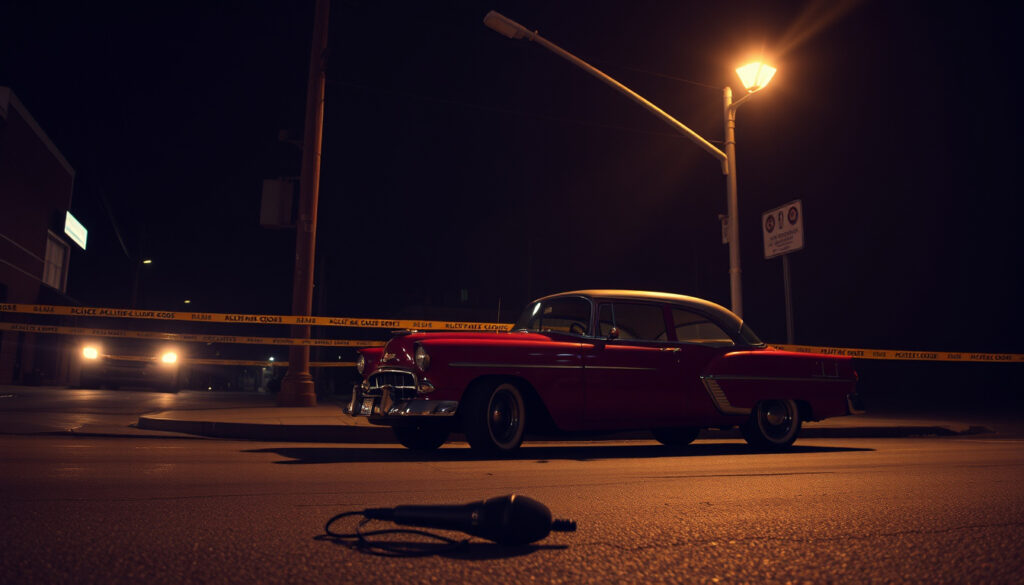
- The assailant vehicle was described as a dark Chevrolet Impala with an unidentified Black male driver wearing a blue or dark suit and bow tie (Us Weekly (entertainment news source))
Immediate aftermath and medical response
- Wallace was rushed to Cedars-Sinai Medical Center, where an emergency thoracotomy was performed (Los Angeles Times (regional newspaper of record))
- He was declared dead at 1:15 a.m. on March 9, 1997 (Los Angeles Times (regional newspaper of record))
Four shots ended a life that had defined East Coast hip-hop. The fact that medical teams attempted an emergency thoracotomy — a last-resort chest-opening procedure — speaks to the severity of his wounds and the desperate effort to save him.
The implication: the speed of the attack and the medical response underscore the suddenness of the murder.
What did Biggie have in his pocket when he died?
The Bible and the letter from his mother
- Biggie had a copy of the Bible and a letter from his mother, Voletta Wallace, in his pocket (Britannica (biographical reference))
- The letter was later used in a song by his mother (Britannica (biographical reference))
Sources and verification
Voletta Wallace later confirmed the letter’s existence in interviews, describing it as a typical mother’s note expressing love and concern. The presence of both items has become a poignant detail in the story of Biggie’s final moments.
The items in his pocket humanize a larger-than-life figure. For fans, the Bible and maternal letter suggest Biggie carried reminders of faith and family even at a party celebrating his success.
The pattern: these personal artifacts shift the narrative from celebrity to humanity.
What happened to Notorious B.I.G.?
The murder on March 9, 1997
- Biggie left a Soul Train Music Awards afterparty at the Petersen Automotive Museum around 12:30 a.m. (Los Angeles Times (regional newspaper of record))
- He was killed in a drive-by shooting at a stoplight in Los Angeles (HISTORY (educational media))
- The shooter used a 9 mm pistol according to multiple accounts (Britannica (biographical reference))
Investigation and conspiracy theories
- The murder remains officially unsolved (Britannica (biographical reference))
- The FBI released files in 2006, but no conclusive findings emerged
- Theories have pointed at rivals within the East Coast-West Coast feud, known associates, and even law enforcement corruption
Aftermath and legacy
- His posthumous album Life After Death debuted at No. 1 on the Billboard 200
- Wallace is widely regarded as one of the greatest rappers of all time (Britannica (biographical reference))
- His death intensified the East Coast-West Coast hip-hop rivalry
Nearly three decades later, the LAPD has named no suspects publicly, yet the case is not officially closed. For Biggie’s family, that means the wound remains open — no justice, no accountability, only decades of theories.
The catch: without closure, the narrative remains frozen in 1997.
Who paid for Notorious B.I.G.’s funeral?
Sean Combs (Diddy) and the funeral costs
- Sean Combs paid for Biggie’s funeral expenses (Britannica (biographical reference))
- The funeral was held at the Frank E. Campbell Funeral Chapel in New York City
- Estimated cost: around $40,000
Other contributors
Family members and friends also contributed to arrangements, but Combs — then Biggie’s label CEO and close friend — covered the bulk of the costs. The gesture underscored their personal and professional bond.
Why did Tupac start hating Biggie?
The 1994 Quad Studios shooting
- On November 30, 1994, Tupac Shakur was robbed and shot at Quad Studios in New York City
- Tupac believed Biggie had prior knowledge of the attack, though no evidence supports this claim
- The incident became the flashpoint for one of hip-hop’s most famous feuds (Britannica (biographical reference))
Perceived disses and escalating tensions
- Biggie’s 1995 track “Who Shot Ya?” was interpreted by Tupac as taunting — though Biggie said it was written before the Quad incident
- Tupac responded with “Hit ‘Em Up” (1996), a vicious diss track targeting Biggie and Bad Boy Records
- The feud was amplified by media coverage, fueling the East Coast-West Coast rivalry
Did they reconcile?
- They never reconciled before Tupac’s death on September 13, 1996
- Some mutual friends have suggested they were on the verge of talking, but no meeting ever occurred
The feud sold records — both artists’ album sales surged during the rivalry. But the cost was human: two unsolved murders, two families devastated, and a generation shaped by a conflict that may have been largely media-fueled.
The trade-off: the commercial success came at an irreplaceable human cost.
Timeline of key events
- Christopher Wallace born in Brooklyn, New York.
- Released debut album ‘Ready to Die’ to critical acclaim.
- Quad Studios shooting – Tupac Shakur is robbed and shot; later suspects Biggie’s involvement.
- Feud escalates with diss tracks; Biggie wins Best Rap Solo at the Grammys.
- Tupac Shakur is shot in Las Vegas; dies on September 13.
- Biggie is killed in a drive-by shooting in Los Angeles.
- Funeral held in New York City; paid for by Sean Combs.
- FBI releases files on the murder investigation; no conclusive findings.
- Netflix documentary ‘Biggie: I Got a Story to Tell’ released.
The timeline shows how quickly the feud escalated to tragedy.
What we know — and what remains unclear
Confirmed facts
- Biggie was shot four times in a drive-by shooting (Britannica (biographical reference))
- He had a Bible and a letter from his mother in his pocket
- Sean Combs paid for the funeral (Britannica (biographical reference))
- The murder remains officially unsolved
- The shooting occurred at approximately 12:47 a.m. after a party at the Petersen Automotive Museum (Los Angeles Times (regional newspaper of record))
What’s unclear
- Who ordered the murder
- The exact motive
- Whether there is any connection to Tupac’s murder
- The identity of the shooter
- Why the case remains unsolved despite investigations by the LAPD and FBI
What remains unclear outweighs what is confirmed, leaving the case open to speculation.
In their own words
“I wrote a letter to my son that was found in his pocket. I told him I loved him and to be careful.”
— Voletta Wallace, Biggie’s mother
“I paid for the funeral because I loved him. He was my brother, my artist, my friend.”
— Sean Combs (Diddy), in various interviews
“The murder of Christopher Wallace remains an open investigation. We have not made any arrests.”
— LAPD detective, speaking about the ongoing case
Summary
The murder of The Notorious B.I.G. marks one of hip-hop’s darkest chapters — a talented artist cut down at 24, leaving a legacy of music and a trail of unanswered questions. For the family, particularly his mother Voletta Wallace, the choice is clear: keep pushing for answers, or accept that justice may never come. For fans, the lesson is that fame offers no protection from the streets, and the East Coast-West Coast rivalry cost more than careers — it cost lives. Also read: Buddy Holly Death and Slash: The Real Story Behind His Guns N’ Roses Departure.
en.wikipedia.org, metro.co.uk, metro.co.uk, de.wikipedia.org, imdb.com, abcnews.go.com, uutisvalo.fi
Frequently asked questions
Where was Biggie shot?
Biggie was shot at a stoplight on Wilshire Boulevard in Los Angeles, after leaving a party at the Petersen Automotive Museum (HISTORY (educational media)).
What was Biggie’s last album before he died?
His last completed album was Life After Death, released posthumously on March 25, 1997 — just 16 days after his murder.
How did Biggie and Tupac’s feud start?
The feud began after Tupac was shot at Quad Studios in November 1994. Tupac believed Biggie had prior knowledge of the attack, though Biggie denied any involvement (Britannica (biographical reference)).
Did Biggie have any children?
Yes. Biggie had two children: T’yanna Wallace (born 1993) with Jan Jackson, and Christopher “C.J.” Wallace Jr. (born 1996) with Faith Evans.
What is the status of the murder investigation?
The murder remains officially unsolved. The LAPD continues to list it as an open investigation, and the FBI released files in 2006 without conclusive findings (Britannica (biographical reference)).
Was Biggie’s murder ever linked to Tupac’s?
No direct link has been proven. However, many conspiracy theories suggest connections between the two murders, given the timing and the East Coast-West Coast feud context (CAAM (cultural museum)).
What is the legacy of Notorious B.I.G.?
Biggie is widely considered one of the greatest rappers of all time. His storytelling ability, distinctive flow, and cultural impact have influenced generations of artists. His music continues to sell millions, and his story is told in documentaries, books, and films.
More related posts
 Oba Femi: Age, Real Name, Accent, Career & First Loss
 Sam Rivers Death: Limp Bizkit Bassist Dies at 48
 Lara Raj: Ethnicity, Religion, Boyfriend, Age Facts
 Marks and Spencer returns: Policy, address, and step-by-step guide
 Normal Heart Rate for Women – Healthy Ranges by Age
 New Balance 9060 Women – Comfort Meets Everyday Style
 Omar Sharif: Egyptian Actor, Gambler, Hollywood Icon