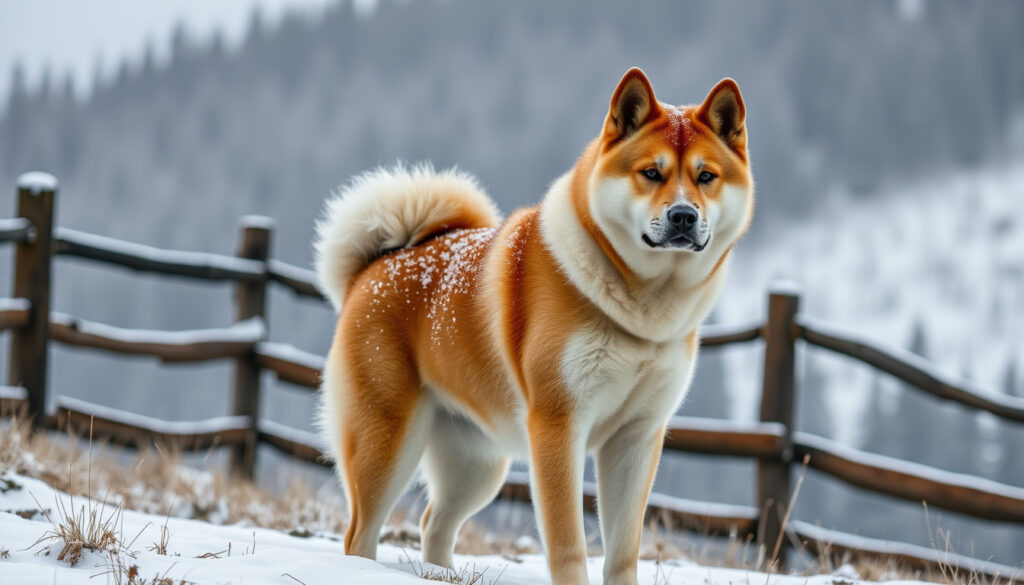
American Akita: Loyal Guardian, Strict Social Code
There’s a reason American Akita owners describe their dogs as “three-year-old children in a fur coat”—they are fiercely loyal, deeply independent, and utterly unimpressed by your authority. Britannica (encyclopedia of animal breeds) describes the Akita as alert, courageous, and protective—traits that make it both an excellent guardian and a challenging family dog. This guide covers temperament, training, legal restrictions, and how the American Akita compares to its Japanese cousin, so you can decide if this breed is right for you.
Average Weight (Male): 70–130 lbs (32–59 kg) ·
Average Weight (Female): 70–100 lbs (32–45 kg) ·
Average Height (Male): 26–28 inches (66–71 cm) ·
Average Height (Female): 24–26 inches (61–66 cm) ·
Lifespan: 10–13 years ·
Origin: Japan (American lineage)
Quick snapshot
- American Akitas are a distinct breed recognized by the AKC since 1972 (Canadian Kennel Club (breed standard))
- Originated from Japanese Akitas bred for size and strength (Britannica) (Canadian Kennel Club (breed standard))
- Strong prey drive and can be dog‑aggressive (Canadian Kennel Club) (Canadian Kennel Club (breed standard))
- Exact prevalence of aggression in well‑socialized American Akitas
- Whether breed‑specific legislation effectively reduces dog bites
- Difference in temperament between male and female American Akitas
- Breed originated in Japan; developed in the United States after World War II (Britannica)
- American Kennel Club recognized the breed as “Akita” in 1972 (Canadian Kennel Club)
- Research local breed‑specific legislation (Hill’s Pet Nutrition (veterinary diet brand))
- Invest in professional training and early socialization (Canadian Kennel Club) (Hill’s Pet Nutrition (veterinary diet brand))
- Prepare for heavy seasonal shedding (Hill’s Pet Nutrition) (Hill’s Pet Nutrition (veterinary diet brand))
Seven key facts about the American Akita, one pattern: this breed demands respect from day one.
| Label | Value |
|---|---|
| Breed Group | Working (AKC) |
| Coat | Double coat; thick and short; colors include white, brindle, pinto |
| Shedding | Heavy (seasonal blows) |
| Temperament | Dignified, courageous, loyal, dominant |
| Good with Children | Yes, if raised together and supervised |
| Good with Other Dogs | Often aggressive; best as only pet |
| Trainability | Independent; requires firm, positive reinforcement |
Are American Akitas good pets?
Temperament and personality
- Loyal and protective of family members (American Kennel Club (breed standard for Japanese Akitainu))
- Reserved and aloof with strangers (Britannica)
- Dignified and self‑confident (American Kennel Club)
An American Akita isn’t a lapdog—it’s a watchful partner. Owners who appreciate a quiet, dignified companion will love the breed; those looking for a gregarious pet may struggle.
Space and exercise needs
- Moderate daily exercise—30 to 60 minutes of brisk walking (Hill’s Pet Nutrition)
- Not high‑energy indoors; content to lounge (Britannica)
- Needs a well‑fenced yard because of jumping ability (Britannica)
Grooming and shedding
- Heavy shedding twice a year (seasonal blows) (Hill’s Pet Nutrition)
- Brush once or twice weekly; daily during peak shedding (Britannica)
- Short double coat requires minimal bathing (Hill’s Pet Nutrition)
The implication: An American Akita is a low‑energy indoor companion but high‑maintenance when it comes to grooming and social boundaries.
How aggressive is an American Akita?
Aggression towards other dogs
- Often intolerant of same‑sex dogs (American Kennel Club)
- Dominant over other dogs (Canadian Kennel Club)
- High prey drive may trigger chasing (Britannica)
Even a well‑trained American Akita may never be trustworthy in dog parks. Owners must manage interactions carefully for the dog’s entire life.
Aggression towards strangers
- Aloof and reserved with unfamiliar people (Canadian Kennel Club)
- Not typically human‑aggressive without provocation (Britannica)
- Barks infrequently, usually as a warning (Canadian Kennel Club)
Factors influencing aggression
- Early socialization reduces but does not eliminate aggression (Hill’s Pet Nutrition)
- Genetics play a strong role; some lines are more reactive (American Kennel Club)
- Training must be firm, consistent, and positive (Hill’s Pet Nutrition)
What this means: Aggression is not inevitable, but the breed’s wiring makes early and consistent training non‑negotiable.
Why are Akitas a restricted breed?
Breed‑specific legislation (BSL) overview
- Akitas frequently appear on banned or restricted breed lists worldwide (Britannica)
- Restrictions vary by country, state, and municipality
Common reasons for restriction
- Perceived aggression and history of severe bites (Hill’s Pet Nutrition)
- Insurance companies may exclude or increase premiums
How to check local laws
- Contact municipal animal control offices
- Check homeowner’s insurance policy exclusions (Hill’s Pet Nutrition)
- Review state‑level BSL databases
The catch: Even well‑behaved Akitas face restrictions because of breed‑wide stigma.
Can an American Akita be left alone?
Independence and separation anxiety
- Can tolerate 4–6 hours alone if well‑adjusted (Britannica)
- Prone to destructive behavior when under‑stimulated (Hill’s Pet Nutrition)
Recommended alone time limits
- Maximum 6 hours unsupervised
- Crate training provides security and prevents damage (Canadian Kennel Club)
Enrichment and boredom prevention
- Puzzle toys and frozen Kongs help occupy the mind
- Daily walks and structured play sessions are essential (Hill’s Pet Nutrition)
Why this matters: An under‑occupied Akita is a destructive Akita—ownership requires a plan for absences.
What is the difference between American Akita and Japanese Akita?
Appearance and size differences
- American Akita larger and heavier: 26–28 inches vs 24–26 inches (Canadian Kennel Club)
- American Akita has a more robust, heavy‑boned build
- Japanese Akita (Akita Inu) has a fox‑like face; American Akita a bear‑like head (American Kennel Club)
Temperament differences
- American Akita more dominant and overtly aggressive toward dogs (Canadian Kennel Club)
- Japanese Akita described as “cat‑like,” more reserved with strangers (American Kennel Club)
- Both are loyal and protective of family (Britannica)
Breed recognition and standards
- AKC recognizes them as separate breeds: American Akita and Japanese Akitainu (2020)
- FCI treats both under one standard with two varieties (Fédération Cynologique Internationale (international breed standard))
- Breed standards differ in acceptable colors and head shape
Three key differences, one pattern: the American Akita is a larger, bolder guardian, while the Japanese Akita is a subtler, more elegant companion.
| Attribute | American Akita | Japanese Akita (Akita Inu) |
|---|---|---|
| Height (at shoulder) | 26–28 inches (male) | 24–26 inches (male) |
| Weight | 70–130 lbs | 55–75 lbs |
| Coat color | All colors including pinto | Red, white, brindle only |
| Head shape | Bears‑like, heavy | Fox‑like, lighter |
| Temperament | Dominant, dog‑aggressive | Reserved, cat‑like |
| Breed recognition (AKC) | American Akita (since 1972) | Japanese Akitainu (since 2020) |
The trade‑off: The American Akita offers a bolder guardian but demands a firmer handler; the Japanese Akita is subtler but no less stubborn.
Pros & Cons of the American Akita
Upsides
- Intensely loyal to family (Canadian Kennel Club)
- Quiet and dignified indoors (Britannica)
- Low energy inside the home
- Excellent guard dog
- Adaptable to various climates (double coat)
Downsides
- Dog‑aggressive, especially same‑sex (American Kennel Club)
- Aloof with strangers (Canadian Kennel Club)
- Heavy seasonal shedding (Hill’s Pet Nutrition)
- Often restricted by BSL and insurance
- Stubborn and independent training style
Eight specifications, one pattern: this is a working breed built for endurance and independence, not eager‑to‑please obedience.
| Specification | American Akita |
|---|---|
| Breed Group | Working (AKC) |
| Coat | Double, short, thick |
| Shedding Level | Very high (seasonal blows) |
| Temperament | Dignified, courageous, loyal, dominant |
| Good with Children | Yes, if raised together |
| Good with Other Dogs | Often aggressive |
| Trainability | Independent; firm positive reinforcement required |
| Exercise Needs | 30–60 min daily |
The pattern: Every spec confirms that the American Akita is designed for owners who can provide structure, respect its independence, and accept its social limitations.
Clarity: What’s Confirmed and What’s Not
Confirmed facts
- American Akitas are a distinct breed recognized by the AKC since 1972 (Canadian Kennel Club)
- They originated from Japanese Akitas bred for size and strength (Britannica)
- They have a strong prey drive and can be dog‑aggressive (American Kennel Club)
What’s unclear
- Exact prevalence of aggression in well‑socialized American Akitas
- Whether breed‑specific legislation effectively reduces dog bites
- Difference in temperament between male and female American Akitas
The open questions: While many claims are backed by kennel club standards, real‑world data on aggression and BSL effectiveness remains scarce.
What Owners and Experts Say
“The Akita is dignified, courageous, and loyal.”
“Akitas can be aggressive towards other dogs and need early socialization.”
PDSA (UK veterinary charity) — breed advice
“They are affectionate and loyal family members but need a firm hand.”
Husky Rescue Ireland — owner testimonial
For anyone considering an American Akita in the UK, the decision is clear: invest in early socialization, firm training, and a secure environment, or face a dog that will dictate the household rules. This breed rewards knowledgeable owners with unmatched loyalty, but it punishes hesitation.
Related reading
- Black Panther: Marvel Superhero, Animal & Film Facts
- Shoe Insoles: Types, Benefits, and When to Choose Custom Orthotics
Expand your knowledge: These articles offer broader context on animal facts and practical comparisons that complement this breed guide.
apexxakitas.com, reddit.com, japaneseakita-inu.co.uk, youtube.com, ckc.ca, northlandakitas.com, reddit.com, digitalcenter.dk
Frequently asked questions
How much does an American Akita cost?
Prices vary widely, but a well‑bred American Akita puppy from a reputable breeder typically costs between $1,000 and $3,000 USD.
Do American Akitas shed a lot?
Yes, they shed heavily year‑round and blow their coat twice a year. Daily brushing during shedding seasons is essential (Britannica).
Are American Akitas good for first‑time owners?
Generally no. Their dominant, independent nature and need for firm training make them challenging for inexperienced handlers (Hill’s Pet Nutrition).
How much exercise does an American Akita need?
About 30–60 minutes of brisk walking daily, plus mental enrichment (Hill’s Pet Nutrition).
Are American Akitas easy to train?
They are intelligent but independent, which can make training a challenge. Firm, positive, and consistent methods work best (Hill’s Pet Nutrition).
What is the lifespan of an American Akita?
Typically 10–13 years.
Can American Akitas live in apartments?
Yes, if given enough daily exercise and mental stimulation. However, their size and potential for nuisance barking make ground‑floor access preferable.
Are American Akitas recognized by the AKC?
Yes, the American Akita has been recognized by the American Kennel Club since 1972 as a member of the Working Group.
More related posts
 Catherine Parr: Life, Death, and True Love of Henry VIII’s Last Wife
 BMW 3 Series for Sale in Ireland – Used Cars Near Me
 Alison King: Relationship, Leaving Corrie & More
 Freya Parks: Biography, Movies, Music, and Current Projects
 Laura Woods: Baby Father, Collapse, and Relationship Updates
 Brandon Lee: The On-Set Accident That Changed Hollywood
 Cast of Say Nothing (TV Series) – Full Cast and Key Roles Guide
 World Championship of Legends – Winners, Teams and How to Watch