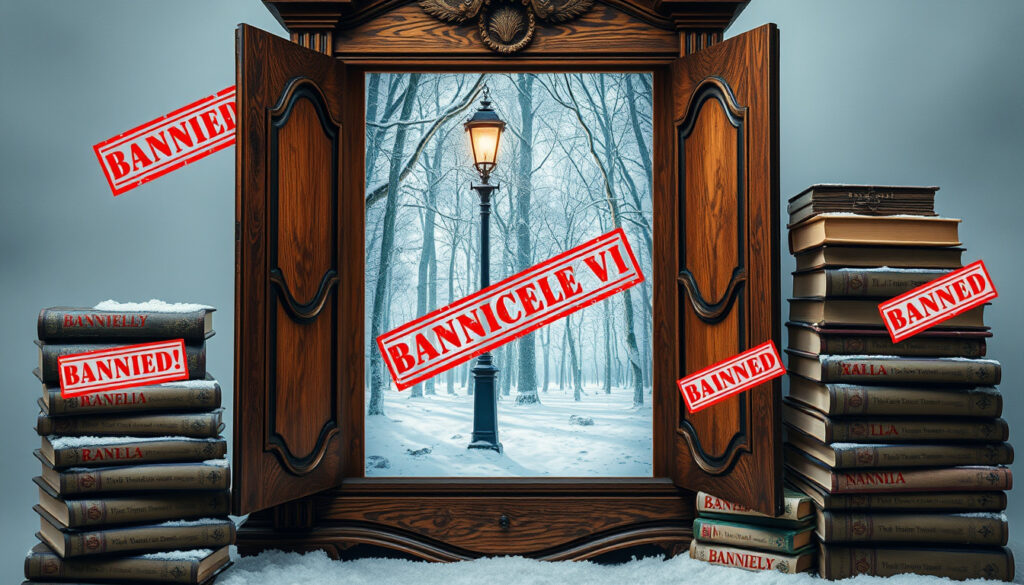
The Chronicles of Narnia: Reading Order, Bans, Controversies
The Chronicles of Narnia spans seven books published between 1950 and 1956, yet the series still ignites fierce debates about reading sequence, book bans, and modern controversies that continue to echo through classrooms today. This guide untangles those disputes so you can navigate the series with clarity.
Author: C. S. Lewis · Books: 7 · Genre: Portal fantasy · Published: 1950-1956 · Major Film Adaptations: 3
Quick snapshot
- 7 books by C. S. Lewis (The Gospel Coalition)
- First published in 1950 (The Gospel Coalition)
- HarperCollins took rights in 1994 and standardized chronological ordering (Wikipedia)
- Exact number of global bans (regional records incomplete)
- Netflix’s 2026 production timeline remains unannounced
- Walter Hooper’s timeline notes disputed by scholars
- HarperCollins 1994 switch to chronological order reshaped how generations read the series
- Renewed adaptation interest after Netflix rights acquisition in 2023
- Potential Magician’s Nephew adaptation reportedly in early development
- Modern controversy debates expected to intensify with any new adaptation
| Fact | Detail |
|---|---|
| Author | C. S. Lewis |
| Books | 7 |
| Years Published | 1950–1956 |
| Illustrator | Pauline Baynes |
| Genre | Fantasy |
| HarperCollins takeover | 1994 |
| Lewis letter on order | 1957 |
| Disney films | 3 (2005–2010) |
What are the 7 Chronicles of Narnia in order?
The Chronicles of Narnia consists of seven novels written by C. S. Lewis between 1949 and 1953, with publication staggered for yearly summer releases. Pauline Baynes illustrated all the books, creating the iconic map and artwork that became inseparable from the series.
Publication order
The original publication sequence, which Macmillan used in the United States and which Lewis himself recommended in correspondence, runs as follows:
- The Lion, the Witch and the Wardrobe (1950)
- Prince Caspian (1951)
- The Voyage of the Dawn Treader (1952)
- The Silver Chair (1953)
- The Horse and His Boy (1954)
- The Magician’s Nephew (1955)
- The Last Battle (1956)
This order reflects how readers originally encountered the series and preserves what scholars call the “symbolic structure” Lewis built into the narrative arc.
Chronological order
The internal Narnian timeline, which Lewis mapped to place events in a fictional realm where time moves differently than on Earth, places The Magician’s Nephew first since it explains how Narnia was created. Chronological ordering runs:
- The Magician’s Nephew
- The Lion, the Witch and the Wardrobe
- The Horse and His Boy (which actually occurs during the first book)
- Prince Caspian
- The Voyage of the Dawn Treader
- The Silver Chair
- The Last Battle
The Horse and His Boy creates a wrinkle in strict chronological reading: its events run parallel to The Lion, the Witch and the Wardrobe, meaning readers following chronological order encounter characters who are simultaneously elsewhere in Narnian time.
HarperCollins adopted the chronological order in 1994 after taking the series rights from Macmillan, making it the worldwide standard for new printings. The change proved controversial among readers who grew up with publication order.
The Magician’s Nephew was written last, not first—Lewis added it later to explain the wardrobe’s origins. Reading it first can deflate the mystery of how the Pevensie children first discover Narnia.
In what order should the Narnia books be read?
The reading order debate has raged since the 1990s, when publishers began numbering the books chronologically instead of by publication date. Scholars and fans remain divided, and Lewis himself offered conflicting signals.
Publication vs chronological debate
Lewis’s secretary Walter Hooper recorded that Lewis preferred chronological order when asked in 1963. In a 1957 letter, Lewis wrote: “I think I agree with your [internal chronology] order for reading the books more than with your mother’s [publication order]” (A Pilgrim in Narnia). Yet Lewis also noted that reading order “does not matter very much.”
Biographer Alister McGrath argues that chronological order “destroys the literary integrity” of The Lion, the Witch and the Wardrobe by revealing Aslan’s sacrificial nature too early (The Gospel Coalition). Theologian Russell Moore calls The Magician’s Nephew “a prequel that ties loose ends” and recommends reading it after the others.
Three distinct reading orders exist: publication order (how Lewis wrote them), composition order (the actual writing sequence), and chronological order (Narnian timeline). Douglas Gresham, Lewis’s stepson, has cited the 1957 letter to argue for chronological reading, while early British editions sometimes used internal chronology while American editions used publication order.
Recommended order for first-time readers
Most scholars and long-time fans recommend publication order for newcomers, as it mirrors Lewis’s own creative journey and preserves narrative surprises. The Lion, the Witch and the Wardrobe works best as an entry point because it introduces Narnia from a child’s perspective—an experience readers of any age can share.
The 1994 switch to chronological numbering affected how an entire generation encountered the series. New readers often believe The Magician’s Nephew was always intended as book one, when in fact it was Lewis’s last addition to the canon.
The pattern is clear: Lewis created the series as he went, building Narnia’s history retroactively. Publishers later reorganized the books to match that retroactively constructed history.
Why was The Chronicles of Narnia banned?
Book challenges targeting The Lion, the Witch and the Wardrobe have occurred periodically since publication, driven by different concerns across decades. Unlike some banned books that face single categories of objection, Narnia has drawn fire from multiple directions.
Historical ban reasons
Some library shelves reportedly removed the book in 1990 for depicting graphic violence, mysticism, and what objectors considered inappropriate supernatural content. The violence of the battle scenes and the magical elements of talking animals and witchcraft worried some parents and librarians.
In 2005, a challenge arose in Florida when then-Governor Jeb Bush selected The Lion, the Witch and the Wardrobe for required school reading. Americans for the Separation of Church and State argued the move was unconstitutional because the novel’s Christ-like Aslan figure promoted Christian theology in public schools (The Hopeful Heroine blog).
Common challenges
Beyond formal bans, the series faces ongoing criticism on several fronts. The Christian allegory troubles some secular readers who view it as religious indoctrination, while some Christian readers object to what they see as watered-down or inaccurate theology. Violent content, magical practices, and the fantasy genre itself draw challenges in more conservative communities.
“Mrs Krieg believed the Narnian books should be read in the order in which they were published, while Lewis agreed with Laurence that they be read chronologically according to Narnian time.”
— Walter Hooper, Lewis’s secretary, recorded the author’s preferred reading order in 1963 (Pints With Jack podcast)
The implication: debates about what to do with Narnia—from reading orders to bans—began during Lewis’s lifetime and reflect the series’ enduring cultural weight.
What is the Narnia controversy?
Modern controversies around the Chronicles of Narnia extend beyond religious objections to encompass questions of representation, sensitivity, and whether classic literature should be updated for contemporary audiences.
Sexism and racism allegations
Philip Pullman, author of the His Dark Materials trilogy, has been the most prominent critic on these grounds. He claimed Narnia is “monumentally disparaging of girls and women” and “blatantly racist” (NarniaWeb analysis). Specific criticisms include:
- Female characters often fulfill passive roles or are characterized as nagging
- The Calormenes, a desert people inspired by Middle Eastern cultures, are frequently depicted as villains or morally inferior
- Only male humans become kings in Narnia; Susan’s exclusion from Aslan’s country is read by some as punishment for growing up
Scholars debate whether these elements reflect Lewis’s time and context or represent enduring biases that children absorb unconsciously. The Horse and His Boy, which centers on Calormene characters, draws particular scrutiny.
Theological criticisms
Christian readers remain divided. Some welcome the allegorical parallels to Christ’s sacrifice and resurrection through Aslan; others argue Lewis sanitized or distorted Christian theology. Russell Moore has noted that Lewis drew from Christian allegory deliberately, while Alister McGrath argues the allegory functions more as inspiration than instruction.
“The chronological approach raises considerable difficulties for readers.”
— Alister McGrath, biographer and scholar (The Gospel Coalition)
The tension between preserving Lewis’s original vision and acknowledging modern critiques has intensified as publishers reconsider other classic series. Penguin Random House has kept the Narnia classics unedited, unlike the edited Roald Dahl editions released by a different publisher—a decision that itself sparked debate about how to handle problematic elements in beloved children’s literature (Newberry Library research guide).
Publishers face a trade-off: unedited classics preserve authorial intent and historical authenticity, but risk normalizing elements modern readers find harmful. Edited versions address contemporary sensibilities but alter the text future generations encounter.
Is Narnia coming back in 2026?
Adaptation interest in Narnia has cycled through various Hollywood phases, with Disney’s three films (2005–2010) representing the most successful theatrical run. Reports suggest renewed activity, though official announcements remain sparse.
Upcoming adaptations
Netflix acquired rights to the Chronicles of Narnia universe in 2023, reportedly as part of a multi-year deal. Walden Media, which produced the Disney films, is no longer involved. The acquisition signaled Netflix’s interest in building a franchise comparable to other streaming fantasy properties.
The Magician’s Nephew plans
Multiple industry reports indicate The Magician’s Nephew as the rumored starting point for any new adaptation. This makes narrative sense: it explains the wardrobe’s origins, establishes the creation myth of Narnia, and avoids retelling the Pevensie children’s story that Disney already covered.
“The Magician’s Nephew is what would be called in today’s film lingo a ‘prequel,’ rather than a beginning.”
— Russell Moore, theologian and author (The Gospel Coalition)
Reportedly, pre-production discussions have mentioned 2026 as a potential target, though Netflix has not confirmed any specific timeline. Any new adaptation will inevitably reignite debates about the source material’s controversies, particularly given current industry sensitivity to representation issues.
Netflix’s approach to the Calormenes and female characters will signal how seriously the streaming giant takes modern critiques. Fan expectations for faithful adaptation clash with contemporary representation standards—a tension Disney navigated poorly with The Voyage of the Dawn Treader.
The pattern: Narnia adaptations succeed when they honor the allegorical heart of Lewis’s work while modernizing presentation. The 2005 film earned praise for its emotional depth; the 2010 sequel’s box office decline reflected creative missteps rather than franchise fatigue.
Timeline
| Year | Event |
|---|---|
| 1950 | The Lion, the Witch and the Wardrobe published |
| 1956 | The Last Battle published, completing the series |
| 1957 | Lewis writes letter favoring internal chronological reading order |
| 1994 | HarperCollins takes series rights, adopts chronological numbering |
| 2005 | Disney releases The Lion, the Witch and the Wardrobe film; Florida school challenge |
| 2023 | Netflix reportedly acquires Narnia adaptation rights |
Confirmed
- 7 books by C. S. Lewis
- The Lion, the Witch and the Wardrobe published 1950
- Publication order: Lion, Witch, Wardrobe first
- HarperCollins standardized chronological order in 1994
- 3 Disney films released 2005-2010
- Lewis preferred chronological order in 1957 letter
Unclear
- Exact number and global distribution of book bans
- Netflix 2026 production timeline (unannounced)
- Walter Hooper timeline notes disputed by Kathryn Lindskoog in 1988
- Whether Narnia ranks among most-challenged books
Key perspectives
“I think I agree with your [internal chronology] order for reading the books more than with your mother’s [published order].”
— C. S. Lewis, author, in a 1957 letter (A Pilgrim in Narnia)
“It is monumentally disparaging of girls and women. It is blatantly racist.”
— Philip Pullman, author and critic (NarniaWeb)
“The Magician’s Nephew is what would be called in today’s film lingo a ‘prequel,’ rather than a beginning.”
— Russell Moore, theologian (The Gospel Coalition)
Publishers and filmmakers continue to grapple with the tension between preserving Lewis’s original vision and responding to modern critiques. Each adaptation rediscovers the series and finds new reasons to celebrate or challenge it. The reading order debate reflects broader questions about authorial intent versus editorial interpretation; the controversies over representation expose tensions between preserving classics and making them accessible to modern audiences. For related literary analysis, see our Lord of the Flies summary. Any Netflix adaptation will land in the middle of these debates whether it wants to or not.
Related reading: Lord of the Flies summary · Game of Thrones map
Fans navigating publication versus chronological reading orders for the seven books often turn to this Narnia reading order guide alongside movie insights before exploring bans and controversies.
Frequently asked questions
What is the plot of The Lion, the Witch and the Wardrobe?
Four English siblings—Peter, Susan, Edmund, and Lucy Pevensie—discover a wardrobe that serves as a portal to Narnia, a land ruled by the White Witch. They join Aslan, a noble lion, to defeat the Witch and free Narnia from eternal winter.
Who are the main characters in The Chronicles of Narnia?
The Pevensie children (Peter, Susan, Edmund, Lucy) appear in the first three books. Other major characters include Aslan the lion, the White Witch (Jadis), Prince Caspian, Reepicheep the mouse knight, Eustace Scrubb, and Jill Pole.
How do the Narnia films compare to the books?
Disney released three films: The Lion, the Witch and the Wardrobe (2005), Prince Caspian (2008), and The Voyage of the Dawn Treader (2010). All were produced by Walden Media. The 2005 adaptation earned praise for emotional depth, while the 2010 sequel underperformed at the box office.
Is The Chronicles of Narnia based on Christianity?
Lewis, a devout Christian, intentionally wove Christian allegory throughout the series, with Aslan’s sacrifice paralleling Christ’s death and resurrection. Lewis insisted the books were not intended as allegory but as supposal—exploring what Christianity would look like in a different world.
How many Chronicles of Narnia films are there?
Three theatrical films were released between 2005 and 2010. Netflix reportedly acquired rights for future adaptations in 2023.
Are there Netflix adaptations of Narnia?
Netflix reportedly acquired adaptation rights in 2023, but has not announced specific projects or timelines. Industry reports suggest The Magician’s Nephew may be the starting point for any new series.
More related posts
 Richard Pryor Biography: Death, Estate, and Comedy Legacy
 Julian McMahon Cause of Death: Cancer at 56
 Mike Bubbins: Welsh Comedian and Former PE Teacher
 Frank Skinner: Wife, Net Worth, Sobriety, and Fatherhood
 Maestro (2023 Film) – Plot, Cast, Reviews & Netflix Guide
 Yasmine Bleeth: Life After Baywatch and Happiness
 James Cameron: Net Worth, Movies, and the $1 Terminator Deal