Cape Verde Travel Guide: Flights, Cost, Safety & More
Ever wondered what it’s actually like to holiday on a remote volcanic archipelago off the coast of West Africa? For Irish travellers swapping the Atlantic drizzle for guaranteed sun, Cape Verde has become a compelling option — but the practical details often trip people up. This guide walks through the key decisions, from booking flights to understanding local costs, so you can plan a trip with confidence.
Population: ~530,000 (as of 2026) ·
Capital: Praia (Santiago island) ·
Official Language: Portuguese ·
Currency: Cape Verdean escudo (CVE) ·
Time Zone: Cape Verde Time (UTC-1) ·
Major Islands: Sal, Boa Vista, Santiago, São Vicente, Santo Antão
Quick snapshot
- Cape Verde is an island nation off West Africa (Britannica)
- Portuguese is the official language (Visit Cabo Verde)
- Irish citizens do not require a visa for stays up to 30 days (Department of Foreign Affairs (Ireland))
- Exact population figures vary by source (World Bank)
- Weather can vary significantly by micro-region and island (Meteo Cabo Verde)
- Flight routes and schedules change seasonally (Skyscanner Ireland)
- Acceptance of euros outside tourist areas is unclear (Visit Cabo Verde (practical info))
- Ryanair launched direct flights from Dublin to Sal in 2024 (Ryanair)
- Tourist arrivals have grown steadily since 2022 (Statistics Cabo Verde)
- More direct flight routes expected from Ireland (Skyscanner Ireland)
- Cape Verde aims for 1 million annual tourists by 2030 (Visit Cabo Verde)
Here are the essential facts about Cape Verde at a glance.
| Attribute | Value |
|---|---|
| Capital | Praia (on Santiago island) |
| Population | ~530,000 (2026 est.) |
| Official Language | Portuguese |
| Currency | Cape Verdean escudo (CVE) |
| Time Zone | Cape Verde Time (UTC-1) |
| Major Islands | Sal, Boa Vista, Santiago, São Vicente, Santo Antão |
| Flight from Ireland | ~6 hours direct to Sal |
Is Cape Verde good for a holiday?
Pros and cons of a Cape Verde holiday
Upsides
- Year-round warm weather with average highs of 25-30°C (Meteo Cabo Verde)
- Excellent beach holidays on Sal and Boa Vista (Visit Cabo Verde)
- Direct flights from Dublin to Sal (~6 hours) available (Ryanair)
- Visa-free entry for Irish citizens up to 30 days (Department of Foreign Affairs (Ireland))
Downsides
- Less developed tourism infrastructure than Canary Islands (Meteo Cabo Verde)
- Limited consular support – no Irish embassy in Cape Verde (Department of Foreign Affairs (Ireland))
- Petty crime in urban areas (GOV.UK Foreign Travel Advice)
- Tap water not always safe (Department of Foreign Affairs (Ireland))
Cape Verde offers reliable winter sun at roughly half the flight time of the Caribbean, but with a less developed tourism infrastructure than the Canary Islands.
Best islands to visit for holidays
- Sal: Best for beach holidays, water sports, and all-inclusive resorts (Visit Cabo Verde (Sal destination))
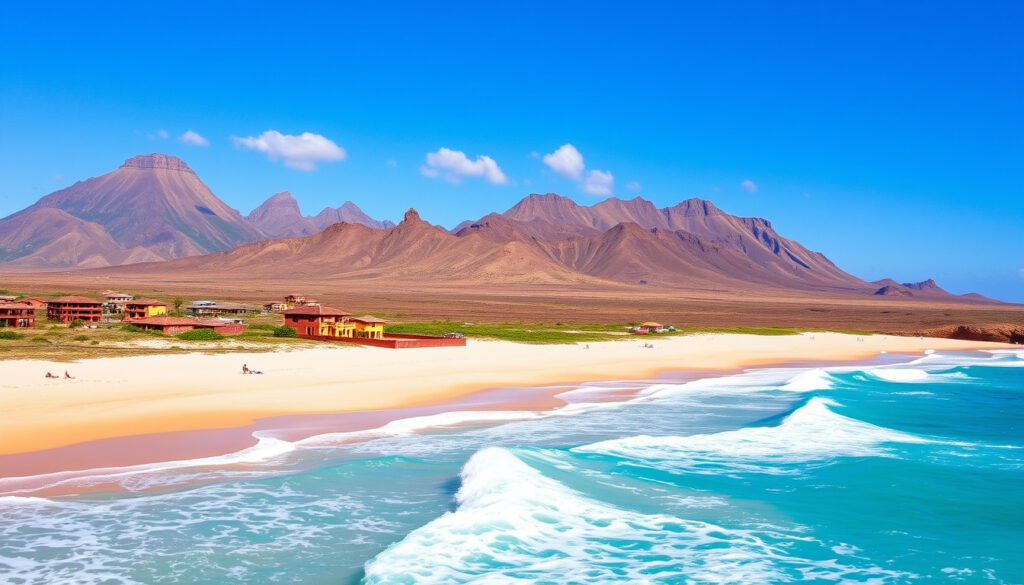
- Boa Vista: Famous for white sand beaches and desert-like landscapes (Visit Cabo Verde (Boa Vista destination))
- Santiago: Cultural hub with the capital Praia and colonial history (Visit Cabo Verde (Santiago destination))
- São Vicente: Music and nightlife in Mindelo (Visit Cabo Verde (São Vicente destination))
Best time to visit Cape Verde
Cape Verde has a tropical dry climate with two main seasons: the dry season (November to July) and the rainy season (August to October). The best time for Irish travellers seeking winter sun is between December and March, when temperatures hover around 25-28°C and rainfall is minimal (Meteo Cabo Verde).
- December – March: Peak tourist season, warm and dry
- April – June: Pleasant weather, fewer crowds
- July – October: Rainy season, hotter and more humid
The pattern: winter and spring offer the most reliable sunshine for Irish holidaymakers, but expect higher prices in December and January.
How do I get to Cape Verde from Ireland?
Flights from Ireland to Cape Verde
Direct flights from Dublin to Sal (Amílcar Cabral International Airport) take approximately 6 hours. Ryanair and TAP Air Portugal operate seasonal services, while connecting flights via Lisbon with TAP add 2-3 hours to the journey (Skyscanner Ireland).
Airlines operating
- Ryanair: Direct from Dublin to Sal (seasonal)
- TAP Air Portugal: Via Lisbon to Sal, Boa Vista, and Santiago
- Portugália (operating for TAP): Seasonal services
Airport information
- Amílcar Cabral International Airport (Sal) — main entry point for tourists
- Aristides Pereira International Airport (Boa Vista) — second largest
- Nelson Mandela International Airport (Santiago) — for the capital Praia
For Irish tourists, the direct flight to Sal is the easiest option, but you’ll need connecting transport if your destination is Boa Vista or Santiago — internal flights or ferries add cost and time to your journey.
The implication: picking the right arrival airport can save you hours of travel time within Cape Verde.
How long is the flight from Ireland to Cape Verde?
Flight duration to different islands
- Dublin to Sal: ~6 hours direct
- Dublin to Boa Vista: ~6.5 hours direct (seasonal)
- Dublin via Lisbon to Santiago: ~9-10 hours including layover
Connecting flights vs direct
Direct flights save 3-4 hours compared to routed options, but they’re seasonal. Connecting via Lisbon with TAP Air Portugal offers more flexibility on dates but adds a layover of several hours (Skyscanner Ireland).
If you’re flexible on dates, a direct flight from Dublin to Sal is the fastest route — about the same as flying to the Canary Islands. If you want Boa Vista or Santiago, factor in an extra 2-3 hours for connections.
The catch: seasonal schedules mean you may not have a direct option when you want to travel.
Is Cape Verde cheap or expensive?
Cost of accommodation
- Budget guesthouses: €30-60 per night
- Mid-range hotels: €60-120 per night
- All-inclusive resorts on Sal: €100-250 per night per person
Food and drink prices
- Local meal (cachupa, grilled fish): €5-10
- Restaurant dinner for two with wine: €25-50
- Bottle of local beer (Strela): €1.50-3
- Imported spirits: €15-25 per bottle
Activities and excursions
- Boat trip (island hopping, dolphin watching): €40-80 per person
- Dune buggy or quad tour on Sal: €50-100
- Scuba diving (single dive): €40-60
Currency and tipping
The official currency is the Cape Verdean escudo (CVE), but euros are widely accepted in tourist areas. ATMs are available in major towns, but carry cash for rural areas. Tipping is not mandatory but appreciated — 10% in restaurants is standard (Visit Cabo Verde (practical info)).
The pattern: your daily spend depends heavily on island choice and accommodation type.
What language do they speak in Cape Verde?
Official language: Portuguese
Portuguese is the official language used in government, education, and media (Britannica).
Cape Verdean Creole (Kriolu)
Crioulo is the everyday language spoken by locals. It’s a Portuguese-based creole with West African influences. There are several regional dialects, with distinct versions on each island (Visit Cabo Verde).
English usage in tourist areas
In hotels, resorts, and tourist-focused businesses on Sal and Boa Vista, English is widely spoken. On less touristy islands like Santiago and Santo Antão, Portuguese and Crioulo dominate (Visit Cabo Verde).
If you only speak English, you’ll get by fine on Sal and Boa Vista. For São Vicente or Santiago, learning a few Portuguese phrases will help — locals appreciate the effort, and it opens up better experiences.
The implication: language barriers are minimal on the main tourist islands but can be a challenge on less visited ones.
What to be careful of in Cape Verde?
Safety tips
- Violent crime is rare, but petty theft like pickpocketing and bag snatching occurs in urban areas, especially in Praia and Mindelo (GOV.UK Foreign Travel Advice)
- Keep valuables secure and avoid walking alone at night in unfamiliar areas (Department of Foreign Affairs (Ireland))
- Canada advises a high degree of caution due to crime, particularly in Santiago (Praia, Fazenda), Sal, Maio, and Boa Vista (Government of Canada travel advice)
- Surveillance cameras under the Safe City programme cover Praia, São Vicente, Sal, and Boa Vista (Visit Cabo Verde (safety info))
Health precautions
- Tap water is not always safe to drink — drink bottled or boiled water (Department of Foreign Affairs (Ireland))
- Zika virus risk exists; pregnant women should consult a doctor (Department of Foreign Affairs (Ireland))
- Hepatitis C is classified as high-risk (Department of Foreign Affairs (Ireland))
- Low malaria risk on Santiago, but generally low risk overall (Department of Foreign Affairs (Ireland))
- Sun protection is essential — UV index is high year-round (Meteo Cabo Verde)
Scams and common issues
- Overcharging for taxis and souvenirs — agree on a price before service
- Fake tour operators — book through official providers (Visit Cabo Verde)
- No Irish Embassy in Cape Verde — assistance is routed through Lisbon or Dublin (Department of Foreign Affairs (Ireland))
Cape Verde is generally safe for tourists who take standard precautions, but the combination of limited Irish consular support and localised crime hotspots means travellers should register their trip with the DFA and keep copies of travel documents separate.
The pattern: proactive travel planning and awareness of your surroundings are key to a trouble‑free trip.
Cape Verde vs Canary Islands: which is right for you?
When deciding between Cape Verde and the Canary Islands, compare these key differences.
| Factor | Cape Verde | Canary Islands (Spain) |
|---|---|---|
| Flight time from Dublin | ~6 hours direct | ~4 hours direct |
| Average winter temp | 25-30°C | 20-25°C |
| Tourism infrastructure | Developing, less crowded | Well-developed, busy |
The trade-off: Cape Verde is warmer and less commercialised, but the Canary Islands have reliable amenities, wider flight options, and consular support on every island.
How to plan your Cape Verde trip (step by step)
- Check passport validity — ensure at least 6 months remaining from your travel date (Department of Foreign Affairs (Ireland))
- Book flights — direct to Sal for convenience, or via Lisbon for more island options
- Arrange accommodation — all-inclusive on Sal for families; boutique hotels on São Vicente for culture
- Get travel insurance — covers medical costs and trip cancellation
- Pack wisely — light clothing, sunscreen, insect repellent, and a universal travel adaptor (Type C/F)
- Check currency — bring euros for easy exchange; cards accepted in resorts
- Register with DFA — allows the Irish embassy to contact you in an emergency (Department of Foreign Affairs (Ireland))
“For an ideal beach holiday, try Sal, Boa Vista and Maio.”
Visit Cabo Verde (official tourism website)
“Cape Verde is among the least populous countries in Africa.”
The bottom line: following these steps ensures you won’t overlook critical travel logistics.
For Irish travellers weighing winter sun options, the decision is clear: Cape Verde delivers reliable warmth and a unique cultural experience, but comes with trade-offs in infrastructure and consular support. Book direct flights to Sal, plan for a mid-range budget, and register with the DFA before you go. If you want guaranteed amenities and quick help in an emergency, the Canary Islands remain the safer bet — but if you’re after genuine Atlantic warmth and a slower pace, Cape Verde wins.
skyscanner.com, roafly.com, skyscanner.net, visit-caboverde.com, momondo.ie, expedia.com, flytap.com, kayak.com, travel.gc.ca, japanworldreport.com
Frequently asked questions
Do I need a visa to visit Cape Verde from Ireland?
No. Irish citizens can stay visa-free for up to 30 days. A valid passport with at least 6 months validity is required (Department of Foreign Affairs (Ireland)).
Is Cape Verde safe for solo travellers?
Yes, with standard precautions. Petty crime exists in cities, so stay aware of your surroundings. Solo travellers should avoid walking alone at night in unfamiliar areas and keep valuables secure (GOV.UK Foreign Travel Advice).
What plug type is used in Cape Verde?
Type C and F plugs (same as Europe). Voltage is 230V. A universal travel adaptor is recommended.
Can I use euros in Cape Verde?
Yes, euros are widely accepted in tourist areas, but you may receive change in escudos. The official currency is the Cape Verdean escudo (CVE).
What is the best month to visit Cape Verde?
December to March offers the most reliable dry weather and comfortable temperatures for Irish travellers. April to June is also pleasant with fewer crowds (Meteo Cabo Verde).
Are there all-inclusive resorts in Cape Verde?
Yes, especially on Sal and Boa Vista. Major options include Riu, Meliá, and TUI Blue resorts. They offer good value for families and couples.
Is Cape Verde a good destination for families?
Yes. Sal and Boa Vista have family-friendly resorts with shallow waters, kids’ clubs, and safe beaches. The direct flight from Dublin makes it accessible for families with young children.
More related posts
 Shoe Insoles: Types, Benefits, and When to Choose Custom Orthotics
 James Cameron: Net Worth, Movies, and the $1 Terminator Deal
 Peter Fonda: Family, Hopper Feud, Death & Net Worth
 Isabel May: Illness, Marriage, Apology Rumors Fact-Checked
 Sydney Martin: Coronation Street Actress Age & Facts
 Tyrrell Hatton: Net Worth, LIV Contract & Career Stats
 Julian Casablancas: Biography, Sobriety, Languages, Net Worth
 Justin Hood: Career, Net Worth, Nickname, China Darts