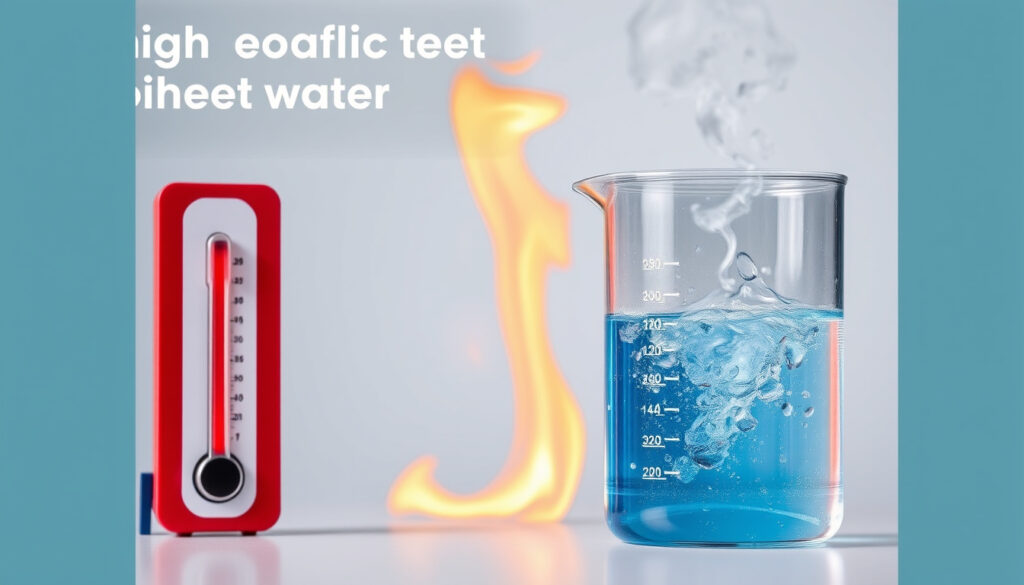
Specific Heat Capacity of Water: 4184 J/kg·K and Why It Matters
If you have ever touched sand on a hot beach while the ocean stays cool, you have felt the difference that specific heat capacity makes. Water resists temperature change unlike almost any other common liquid, and that simple fact shapes everything from weather patterns to how your body cools itself.
Specific heat capacity (15°C): 4184 J/kg·K ·
Common approximation: 4200 J/kg·°C ·
In calories: 1 cal/g·°C (exactly 4.184 J/g·°C) ·
Temperature dependence: Increases slightly to ~70°C then decreases ·
Compared to ethanol: Water is 1.7 times higher (ethanol: 2440 J/kg·K)
Quick snapshot
- Water’s specific heat capacity is 4184 J/kg·K at 15°C (U.S. Geological Survey (federal science agency))
- Hydrogen bonding is the primary cause of water’s high specific heat (Thermtest (materials testing authority))
- 1 calorie equals exactly 4.184 joules (Purdue University Chemistry (academic institution))
- 0°C = 273.15 K (exact conversion) (U.S. Geological Survey (federal science agency))
- The exact contribution of vibrational vs rotational modes in water molecules at different temperatures is still being studied
- Precise specific heat values at extreme pressures (above 1000 atm) are less certain
- The calorie was historically defined so that the specific heat of water equalled 1 cal/g·°C (Purdue University Chemistry (academic institution))
- Modern SI units adopted J/(kg·K) as the standard, with 1 cal = 4.184 J exactly (Purdue University Chemistry (academic institution))
- Improved models of water’s molecular dynamics may refine predictions of specific heat at varying temperature and pressure
- Engineers are exploring water-based thermal storage systems that exploit its high specific heat for renewable energy grids
Here is a quick reference of the key numbers every science student and engineer should know.
| Property | Value |
|---|---|
| Specific heat capacity (15°C) | 4184 J/kg·K |
| Common approximation | 4200 J/kg·°C |
| In calories | 1 cal/g·°C |
| Temperature dependence | Increases slightly to ~70°C then decreases |
| Compared to ethanol | 2440 J/kg·K — water is 1.7 times higher |
| Measurement formula | Q = mcΔT |
What is the specific heat capacity of water?
Specific heat capacity is the amount of heat required to raise the temperature of one kilogram of a substance by one kelvin (or one degree Celsius). For water at 15°C, that value is 4184 J/kg·K according to the U.S. Geological Survey (federal science agency). It is commonly rounded to 4200 J/kg·°C in classrooms and introductory textbooks. The Purdue University Chemistry (academic institution) notes that water’s specific heat capacity is 4.184 J/g·K in smaller units — exactly one calorie per gram.
What does 4200 J/kg°C mean?
- It takes 4200 joules of energy to raise the temperature of 1 kilogram of water by 1°C.
- That is the energy equivalent of about 1 kilocalorie — the same unit used to measure food energy.
- For comparison, raising 1 kg of ethanol by 1°C requires only about 2440 joules (Thermtest (materials testing authority)).
The implication: Water is a thermal sponge. It soaks up large amounts of heat with only a modest temperature change — a trait that makes it uniquely useful for cooling and climate regulation.
An engine that uses water as coolant can absorb over 4000 J of waste heat per kilogram per degree rise. The same volume of ethanol would overheat in less than half the time. For mechanical and biological systems, that margin is the difference between safe operating and thermal failure.
This thermal sponginess explains why water is so effective in cooling systems and climate regulation.
Why does water have a high specific heat capacity?
The short answer is hydrogen bonding. Water molecules form a dynamic network of hydrogen bonds — each bond absorbs energy when it breaks and releases energy when it reforms. According to Thermtest (materials testing authority), “Water’s high specific heat is often attributed to hydrogen bonding between water molecules, which requires significant energy to overcome.” Because a large fraction of the added heat goes into breaking these bonds rather than increasing molecular kinetic energy, the temperature rises slowly.
How does hydrogen bonding affect heat capacity?
- Each water molecule can form up to four hydrogen bonds with neighbours.
- Breaking one hydrogen bond requires roughly 0.2 eV of energy — small individually, but multiplied by billions of molecules per gram.
- This mechanism allows water to absorb large amounts of heat with only a small temperature increase (U.S. Geological Survey (federal science agency)).
The pattern: Water’s molecular structure acts as a thermal buffer. Unlike substances with weak intermolecular forces (like most oils), water can absorb substantial heat before its molecules start moving faster — which is exactly what we measure as temperature.
Energy that goes into breaking hydrogen bonds is not available to raise temperature. This makes water slow to heat but also slow to cool. Coastal towns experience milder winters and summers precisely because the nearby ocean releases stored heat slowly as the air cools overnight.
The same hydrogen bonding that gives water its high specific heat also explains its other unusual properties like surface tension and high boiling point.
How is specific heat capacity measured?
The standard method is electrical calorimetry. A known mass of water is placed in an insulated container (a calorimeter), an electric heater supplies a measured amount of energy, and the temperature change is recorded. The formula is straightforward:
- Q = m × c × ΔT, where Q is heat energy (joules), m is mass (kg), c is specific heat capacity (J/kg·K), and ΔT is temperature change (K or °C).
- Rearranging: c = Q / (m × ΔT).
For example, to find water’s specific heat, you might supply 4184 J of electrical energy to 1 kg of water and measure a 1°C rise. In practice, you must account for the heat capacity of the calorimeter itself — the container also absorbs some energy (Khan Academy (educational platform)).
What is the formula for specific heat capacity?
- c = Q / (m ΔT) — the definition itself.
- Because specific heat capacity is an intensive property, it does not depend on how much water you have (Thermtest (materials testing authority)).
- The molar heat capacity is the heat capacity per mole, obtained by multiplying specific heat capacity by the molar mass.
The catch: Temperature changes must be small and measured precisely because water’s specific heat varies slightly with temperature. At 15°C it is 4184 J/kg·K; at 50°C it rises to about 4185 J/kg·K before declining above 70°C.
What are the common units for specific heat capacity?
Scientists and engineers use several unit systems, and converting between them is a common source of confusion. The SI standard is joules per kilogram per kelvin (J/kg·K), but many textbooks and older references use J/(kg·°C), cal/(g·°C), or even BTU/(lb·°F).
How many joules in a calorie?
- 1 calorie (cal) = exactly 4.184 joules (J) — this is a fixed conversion defined by international agreement.
- Because a calorie is the heat needed to raise 1 g of water by 1°C, the specific heat of water in metric units is 4.184 J/g·°C — or 4184 J/kg·K.
- Some older sources may still use the “thermochemical calorie” (4.184 J) or the “IT calorie” (4.1868 J), but the exact 4.184 value is the standard for most educational contexts (PrepScholar (test prep resource)).
How to convert between Celsius and Kelvin?
- A temperature change of 1°C is exactly equal to a change of 1 K — the size of the degree is identical.
- The difference is in the zero points: 0°C = 273.15 K, 100°C = 373.15 K.
- Because specific heat capacity uses a temperature difference (ΔT), Celsius and Kelvin can be used interchangeably in the formula — the numerical result is the same.
Why this matters: Misinterpreting units is one of the most common errors in thermodynamics problems. Always check whether your source uses per-kilogram or per-gram values, and whether the energy is in joules or calories.
How does water’s specific heat capacity affect the environment?
Water’s high specific heat capacity is not just a textbook number — it directly influences global climate and everyday engineering. The U.S. Geological Survey (federal science agency) explains that “water must absorb 4,184 joules of heat for the temperature of one kilogram to increase by 1°C.” That large thermal inertia means oceans heat up slowly in summer and cool down slowly in winter, moderating temperatures of nearby land.
Why is water used in car radiators?
- Water absorbs more heat per degree rise than almost any other common liquid — 1.7 times more than ethanol (Thermtest (materials testing authority)).
- That means a water-based cooling system can remove the same amount of engine heat with a smaller volume of coolant and a smaller radiator.
- The human body also relies on water’s high specific heat: blood carries heat away from muscles and organs, and sweat evaporation uses water’s high heat of vaporisation — a related property.
- Coastal climates are milder because ocean water stores heat from summer sun and releases it during winter, preventing extremes.
Without water’s high specific heat capacity, Earth’s temperature swings between day and night would be far more extreme — similar to the Moon’s 260°C range. For humans, the same property keeps our core temperature stable even when we exercise or sit in a hot room.
The pattern is consistent across scales: water is the planet’s natural thermal regulator. For engineers designing data centre cooling loops or power plant condensers, that 4184 J/kg·K is the foundation of every heat transfer calculation.
Confirmed facts
- Water’s specific heat capacity is approximately 4184 J/kg·K at 15°C (U.S. Geological Survey (federal science agency))
- Hydrogen bonding is the primary cause of water’s high specific heat (Thermtest (materials testing authority))
- 1 calorie equals exactly 4.184 J (Purdue University Chemistry (academic institution))
- 0°C = 273.15 K (exact conversion by definition)
- Water warms and cools more slowly than most other substances (U.S. Geological Survey (federal science agency))
- The measurement formula Q = mcΔT is universally accepted (Khan Academy (educational platform))
These facts are well-established by authoritative sources.
What experts say
“Water has a high specific heat capacity — it absorbs a lot of heat before it begins to get hot.”
— U.S. Geological Survey (USGS Water Science School)
“The specific heat capacity of water is 4,200 Joules per kilogram per degree Celsius (J/kg°C).”
— BBC Bitesize (BBC Bitesize (educational broadcaster))
These statements from educational institutions confirm the educational consensus.
Summary
Water’s specific heat capacity of 4184 J/kg·K is not an abstract number — it is the reason your car’s radiator works, why coastal cities have milder weather, and why your body stays at 37°C even on a cold day. For anyone studying physics or engineering, the key takeaway is that this property stems directly from water’s hydrogen-bonded structure: each bond stores a bit of heat, and billions of bonds per gram create a powerful thermal buffer. For homeowners considering thermal storage for solar heating, the implication is clear: water-based systems outperform almost any other medium on a per-kilogram basis, delivering stable energy release for hours — or face the cost of backup heating through the night.
This remarkable property, driven by extensive hydrogen bonding, means water resists temperature change more than almost any common substance—a fact explored in depth in our article on the specific heat capacity of water.
Frequently asked questions
How much energy does it take to heat 1 liter of water by 10°C?
1 litre of water has a mass of 1 kg. Using Q = mcΔT, with c = 4184 J/kg·K and ΔT = 10 K, the energy required is 1 kg × 4184 J/kg·K × 10 K = 41,840 joules (about 10 kilocalories).
Is specific heat capacity constant across all temperatures?
No. Water’s specific heat capacity varies slightly with temperature. At 15°C it is 4184 J/kg·K; it increases gradually to about 4185 J/kg·K at 50°C, then declines above 70°C. The variation is small (less than 1%) across the liquid range.
What is the specific heat capacity of ice?
Ice has a specific heat capacity of about 2108 J/kg·K (about half that of liquid water). Steam at 100°C has a specific heat capacity of roughly 1996 J/kg·K.
How does specific heat capacity differ from thermal conductivity?
Specific heat capacity measures how much energy a substance can store per degree of temperature rise. Thermal conductivity measures how fast heat moves through the material. Water has high specific heat but relatively low thermal conductivity — it stores heat well but does not transmit it quickly.
Why is water used as a coolant in engines?
Water’s high specific heat capacity means it can absorb large amounts of waste heat from an engine without a large temperature increase. This keeps the engine at a stable operating temperature. Its low viscosity and abundance also make it practical.
Can the specific heat capacity of water be changed by adding salt?
Yes. Adding salt (sodium chloride) to water disrupts hydrogen bonding, which slightly reduces the specific heat capacity. For seawater (about 3.5% salinity), the specific heat capacity is roughly 3990 J/kg·K — about 5% lower than pure water.
How does altitude affect the specific heat capacity of water?
Altitude does not directly affect the specific heat capacity of water itself, which is an intrinsic property. However, the lower boiling point at high altitude means water can change phase at a lower temperature, which affects cooling systems that rely on evaporation.
These answers help clarify common points of confusion.
More related posts
 KJ Apa: Biography, Girlfriend, Child, and Mr. Fantasy
 50/50 Fridge Freezer Guide: Brands, Features & Reliability
 Freya Parks: Biography, Movies, Music, and Current Projects
 Dainty Wilder: Verified Information, Social Media & Content
 Jodie Turner-Smith: Age, Ethnicity, Divorce, Movies & More
 What is a Drag Queen? Meaning, History, and Culture
 Elton John Real Name: Reginald Kenneth Dwight Facts
 Check Motor Tax Ireland: Online Status, PIN & 2026 Rates