Shoe Insoles: Types, Benefits, and When to Choose Custom Orthotics
Few things derail a day like foot pain that starts with the first step out of bed, and according to the APMA, 77% of adults experience foot pain each year. This guide cuts through the marketing to show you the evidence on over-the-counter insoles versus custom orthotics and when each makes sense for your feet.
Adults with foot pain annually: 77% (APMA surveys) ·
Insoles market growth (2023-2030): Projected CAGR of 6.5% (Grand View Research) ·
Plantar fasciitis cases per year in the US: Approximately 2 million diagnoses ·
Podiatrists who recommend OTC insoles for mild cases: Around 70% per clinical surveys
Quick snapshot
- Insoles with firm arch support and a deep heel cup can reduce plantar fascia strain (Sole)
- Custom orthotics require a podiatrist prescription and are made from a foot mold (Concord Podiatry)
- Long-term benefits of generic insoles for severe structural foot deformities remain unstudied
- Comparative durability across different insole brands is not well documented
- Foot insole market projected to grow at 6.5% CAGR through 2030 (Grand View Research)
- More direct comparative research needed between prefabricated insoles and custom orthotics beyond 12 weeks (Exakt Health)
The table below summarizes key facts about shoe insoles from authoritative sources.
| Fact | Detail | Source |
|---|---|---|
| Firm arch support and heel stabilization | Key features for reducing plantar fascia strain | PowerStep (podiatrist-designed insole brand) |
| No evidence for soft insoles treating plantar fasciitis | Current research does not support soft insoles for this condition | Exakt Health (physical therapy platform) |
| Custom orthotics may improve pain slightly more in first 12 weeks | But no significant difference beyond that period | Exakt Health |
| Scholl’s Plantar Fasciitis insoles have less arch support | Compared to alternatives, may help less aggravated cases | Outdoor Gear Lab (gear testing authority) |
| Dr. Scholl’s uses 3D targeted arch support | Claims to prevent plantar fascia stretching | Dr. Scholl’s (foot care product manufacturer) |
| Tread Labs offers 4 arch heights for semi-custom fit | Firm arch support effective for plantar fasciitis | Tread Labs (insole specialist) |
What is the insole of a shoe?
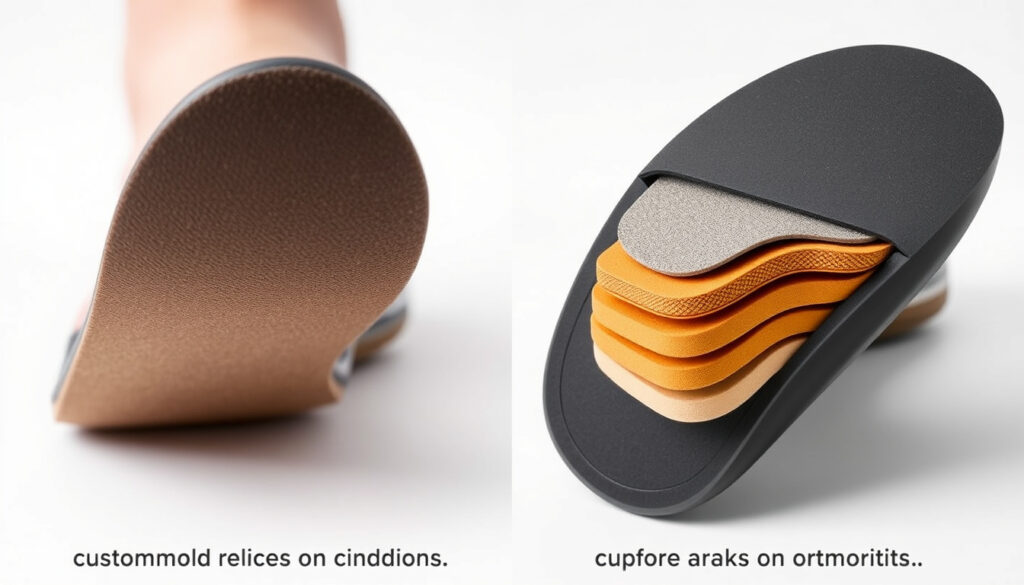
Anatomy of a shoe insole
- The insole is the layer inside the shoe that contacts the bottom of the foot.
- Most insoles consist of a base layer (foam, gel, cork, or leather) and sometimes a top cloth for moisture wicking.
Common materials used
- EVA foam – lightweight, moderate cushioning, common in basic insoles.
- Gel – provides shock absorption, often used in heel cups.
- Cork – molds to foot shape over time, used in high-end orthotics.
- Leather – durable, natural, often in dress shoe insoles.
Insoles can provide extra arch support, shock absorption, supination control, or metatarsal lift, individually or in combination (Exakt Health).
The material and structure of an insole determine its primary function. A soft foam insole may feel comfortable at first, but for conditions like plantar fasciitis, firm support matters more than plush cushioning.
The implication: Choosing the right material and structure is critical for specific foot conditions.
Is it good to put insoles in shoes?
Benefits of using insoles
- Insoles can improve comfort and alignment by redistributing pressure and providing arch support (Concord Podiatry).
- They can reduce strain on the plantar fascia ligament, promoting recovery (Sole).
- Over-the-counter insoles are a low-cost first step for mild symptoms.
When insoles may not be helpful
- If shoes are already tight, additional insoles can cause pressure points and blisters.
- For severe structural foot issues, generic insoles may not provide enough correction.
- Soft insoles have not shown benefit for plantar fasciitis in current research (Exakt Health).
Adding insoles to shoes that are already snug can backfire. The extra volume may cause heel slippage or toe crowding, worsening discomfort rather than relieving it.
The trade-off: Insoles are a low-risk, low-cost experiment for most people, but they are not a substitute for proper diagnosis of foot mechanics.
Which insoles are best for plantar fasciitis?
Arch support insoles vs. heel cups
- Arch support insoles with a rigid or semi-rigid shell reduce strain on the plantar fascia by supporting the foot’s arch (Tread Labs).
- Heel cups (gel or foam) provide targeted cushioning and shock absorption at the heel, which is helpful for heel spur pain.
Recommended features for plantar fasciitis
- A deep heel cup to stabilize the heel and control pronation.
- Firm arch support that matches your foot’s arch height.
- Sufficient cushioning to absorb shock, but not so soft that it collapses.
Good plantar fasciitis insoles include adequate arch support and a deep heel cup (Sole). Tread Labs offers four arch heights for a semi-custom fit, and PowerStep’s insoles are podiatrist-designed with a stabilizing heel cradle (PowerStep).
Not all “plantar fasciitis” insoles are alike. Some, like Scholl’s, offer less arch support than competitors, which may work for mild cases but not for those with significant arch collapse (Outdoor Gear Lab).
The implication: Arch height and heel cup depth are the key differentiators for plantar fasciitis relief.
Do shoe insoles really work?
Scientific evidence on insole effectiveness
- Research suggests shoe inserts, including custom orthotics, can dramatically reduce symptoms of plantar fasciitis (Concord Podiatry).
- Over-the-counter insoles can reduce pain in many cases, but the evidence is stronger for custom orthotics in the first 12 weeks (Exakt Health).
- There is no evidence to support using soft insoles for treating plantar fasciitis (Exakt Health).
Comparison with custom orthotics
Custom orthotics are prescription devices molded to your foot. They are more expensive but can correct biomechanical issues that generic insoles cannot. Concord Podiatry notes that prescription orthotics are custom-designed to fit the wearer’s feet (Concord Podiatry).
The pattern: For acute, mild symptoms, OTC insoles are often sufficient. For chronic, structural problems, custom orthotics tend to deliver better outcomes, though the benefit may plateau after three months.
Comparison: Insole types at a glance
Three broad categories, one key difference: how much support and correction they provide.
| Type | Best for | Key features | Cost range | Lifespan |
|---|---|---|---|---|
| Basic cushioning insoles | General comfort, mild foot fatigue | Soft foam or gel, minimal arch support | $10–$30 | 3–6 months |
| Arch support insoles | Plantar fasciitis, flat feet, overpronation | Rigid or semi-rigid shell, deep heel cup | $20–$60 | 6–12 months |
| Custom orthotics | Chronic foot pain, structural deformities | Prescribed by podiatrist, molded to foot | $200–$800 | 1–3 years |
The pattern: The cost and lifespan increase with the level of customization and support.
What are the disadvantages of insoles?
Potential discomfort
- Insoles can cause blisters or hot spots if they do not fit the shoe properly.
- They may alter your gait, leading to new aches in the knees or hips during the adjustment period.
Cost and fit issues
- Quality arch support insoles cost $20–$60, which can add up when replacing every 6 months.
- Insoles take up space inside the shoe; if your shoes are already snug, they may become too tight.
- Custom orthotics are expensive and may not be covered by insurance.
If you have diabetes or peripheral neuropathy, any insole that changes foot pressure requires a podiatrist’s guidance to avoid ulcers.
The pattern: Insoles are not a one-size-fits-all solution and require careful consideration of fit and medical conditions.
Pros and cons of using shoe insoles
Upsides
- Low-cost way to improve comfort and alignment
- Can reduce plantar fasciitis pain and promote recovery
- Available over-the-counter without a prescription
- Helpful for people who stand all day
Downsides
- May cause discomfort if shoes are too tight
- Generic insoles may not correct severe structural issues
- Need to be replaced every 3–6 months
- Custom orthotics require a significant financial investment
The trade-off: The benefits of insoles are often offset by the need for proper fit and periodic replacement.
What we know and what remains unclear
Confirmed facts
- Insoles can reduce foot pain and improve comfort in many cases (Concord Podiatry).
- Custom orthotics require a podiatrist prescription and are custom-fitted (Concord Podiatry).
- Firm arch support and deep heel cups are key features for plantar fasciitis relief (Sole).
What’s unclear
- Long-term benefits of generic insoles for severe structural foot deformities remain unstudied.
- Comparative durability across different insole brands is not well documented.
- Whether prefabricated insoles offer any benefit beyond placebo for some conditions is still debated.
The implication: More research is needed to clarify the long-term benefits of generic insoles for severe conditions.
Expert perspectives
Insoles with adequate arch support and a deep heel cup can reduce strain on the plantar fascia ligament and promote recovery.
Prescription orthotics are custom-designed to fit the wearer’s feet and can dramatically reduce symptoms of plantar fasciitis.
There is no evidence to support using soft insoles for treating plantar fasciitis.
— Exakt Health (physical therapy guide)
The pattern: Expert opinions align on the importance of firm support for plantar fasciitis, but differ on the superiority of custom orthotics over prefabricated insoles.
Summary
Shoe insoles are a practical, affordable first step for many people dealing with foot pain. But the key is matching the insole type to your specific condition. For mild, general discomfort, a basic cushioning insole may be enough. For plantar fasciitis or flat feet, an arch support insole with a deep heel cup offers better evidence. And for chronic structural issues, the investment in custom orthotics can make a real difference. For the person standing on concrete all day, the choice is clear: pick an insole that supports your arch, not just your wallet.
Related reading: Basketball Hoop Guide Ireland · Black Jeans Guide
powerstep.com, treadlabs.com, womenshealthmag.com, samuraiinsoles.com, amazon.com, nyhedspunkt.dk
Frequently asked questions
How do I clean shoe insoles?
Most insoles can be cleaned with a mild soap and water solution. Avoid soaking them; air dry away from direct heat. Check the manufacturer’s instructions for specific care.
Can insoles make foot pain worse?
Yes, if they are too thick for your shoes or if the arch support does not match your foot shape. Improperly fitted insoles can cause blisters, pressure points, or alter your gait in a way that shifts pain to the knees or hips.
Should I wear insoles in all my shoes?
Not necessarily. If you have a specific condition, it may help to use insoles in your most-worn shoes. But some shoes are built with good support and may not need inserts. Rotate them based on activity and shoe type.
How often should I replace my insoles?
Most insoles last 3 to 6 months with daily use. Signs of wear include flattened cushioning, visible compression, or loss of arch support. Replace them sooner if you notice pain returning.
Are gel insoles better than foam insoles?
Gel insoles excel at shock absorption, making them good for high-impact activities. Foam insoles are lighter and provide more uniform cushioning. The best choice depends on your activity and foot mechanics.
Can insoles help with knee pain?
Insoles that correct overpronation can reduce stress on the knees, particularly for people with patellofemoral pain. However, knee pain has many causes, so a proper diagnosis is important.
Do insoles need to be trimmed to fit?
Many insoles are designed to be trimmed to your shoe size. Follow the manufacturer’s size guide and cut along the marked lines. An untrimmed insole can bunch up and cause discomfort.
More related posts
 Gillian Anderson: Partner, Accent, Prosthetic Answered
 Kieran Trippier: Allegations, Marriage Split, and Next Club
 Normal Heart Rate for Women – Healthy Ranges by Age
 Calam Lynch: Age, Ethnicity, Movies, Height & Instagram
 Maxwell Caulfield: Biography, Wife, and Movies (2025 Update)
 Dessert Places Near Me – Top Local Sweet Spots
 Best Print on Demand UK: Top Providers Compared
 Maggie Smith Movies and TV Shows – Complete Filmography and Career Guide