Joseph Stalin: Rise, Reign, Death, and Legacy
Joseph Stalin’s name evokes both reverence and revulsion as the Soviet leader who crushed Nazi Germany while also presiding over a regime that starved and executed millions of his own people.
Birth: 18 December 1878 ·
Death: 5 March 1953 ·
Years in Power: 1922 – 1953 (31 years) ·
Estimated Deaths Under His Rule: 3–6 million ·
Role: Leader of the Soviet Union
Quick snapshot
- Stalin was born 18 December 1878 in Gori, Georgia (Encyclopaedia Britannica).
- He led the Soviet Union from 1924 until his death in 1953 (Wikipedia).
- His regime caused millions of deaths through the Great Purge and forced collectivization (BBC Teach).
- Exact number of deaths attributable to Stalin’s policies remains disputed (Encyclopaedia Britannica).
- Whether Stalin was poisoned or died of natural causes (stroke) is contested (New World Encyclopedia).
- Stalin’s exact height (reported 1.68 m but often exaggerated) (Encyclopaedia Britannica).
- 30 April 1945: Hitler commits suicide; Stalin orders search for his body (Encyclopaedia Britannica).
- 1 March 1953: Stalin suffers a stroke; dies 5 March (New World Encyclopedia).
- Polls in 2023 show 70% of Russians view Stalin positively (Encyclopaedia Britannica).
- Debates over his legacy continue, with state media reframing him as a strong leader (BBC Teach).
Eight snapshot facts, one pattern: Stalin’s life spanned revolutionary poverty to absolute power, yet key details of his death and physical appearance remain contested.
| Label | Value |
|---|---|
| Full Name | Iosef Vissarionovich Dzhugashvili (Joseph Stalin) |
| Born | 18 December 1878, Gori, Georgia |
| Died | 5 March 1953, Moscow, Russia |
| Cause of Death | Cerebral hemorrhage (official); poisoning theories persist |
| Height | 1.68 m (5 ft 6 in) – often disputed |
| Religion | Former orthodox seminary student; publicly atheist |
| Role | General Secretary of the Communist Party of the Soviet Union (1922–1953) |
| Years in Power | 1924 (de facto) – 1953 |
Who was Joseph Stalin and why was he important?
Early life and rise to power
- Stalin was born Ioseb Besarionis dze Jughashvili on 18 December 1878 in Gori, Georgia, then part of the Russian Empire (Wikipedia).
- He attended Tiflis Seminary but was expelled for revolutionary activity (Wikipedia).
- After the 1917 Bolshevik Revolution, he held key posts including Commissar for Nationalities (Ohio State University eHistory).
Role in the Russian Revolution
- Stalin was a central organizer during the Bolshevik seizure of power (Encyclopaedia Britannica).
- He edited the party newspaper Pravda and helped plan the uprising (Ohio State University eHistory).
Consolidation of control
- After Lenin’s death in 1924, Stalin outmaneuvered rivals and became absolute ruler by the late 1920s (Encyclopaedia Britannica).
- He launched Five-Year Plans and forced collectivization, causing widespread famine (BBC Teach).
Stalin’s rapid industrialization built a military powerhouse but at a human cost—millions died in the Holodomor and labor camps. Modern Russia still wrestles with that balance.
The implication: Stalin’s rise from seminary dropout to dictator was fueled by ruthless tactics that later defined his rule.
Why was Joseph Stalin so popular?
Role in defeating Nazi Germany
- Stalin led the Soviet war effort after Germany’s 1941 invasion, attending Allied conferences at Tehran and Yalta (Encyclopaedia Britannica).
- The Red Army’s victory in Berlin cemented him as a wartime savior (BBC Teach).
Post-war Soviet pride and propaganda
- State media promoted Stalin as a father-figure and “Man of Steel” (BBC Teach).
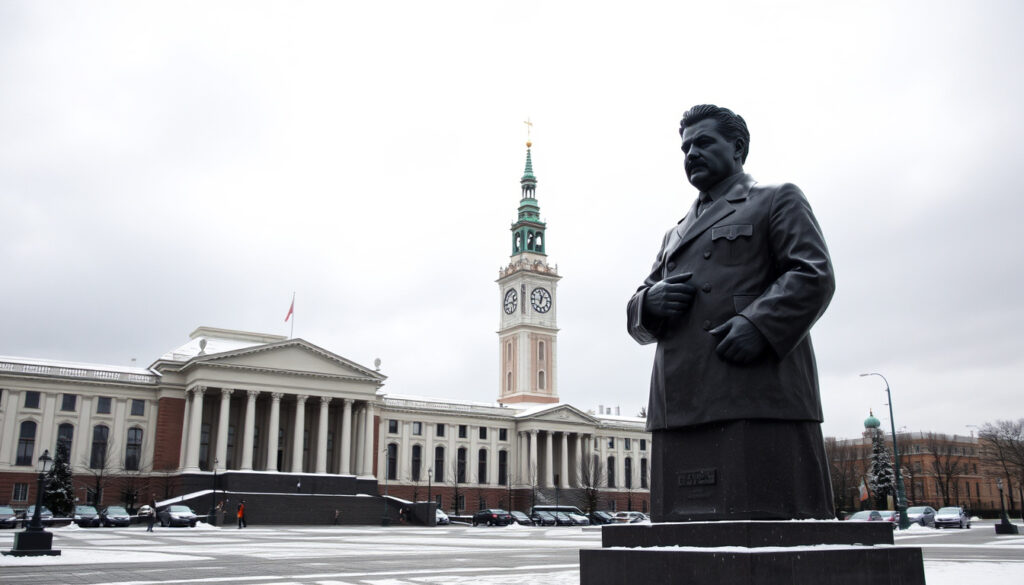
- His cult of personality was immense—statues, slogans, and daily adulation (Encyclopaedia Britannica).
Modern nostalgia in Russia
- In 2023, a Levada Center poll found 70% of Russians view Stalin positively (Encyclopaedia Britannica).
- Many credit him with industrial growth and victory, downplaying the terror (BBC Teach).
Stalin’s popularity today rests on the same authoritarian methods that killed millions. For many Russians, the end—global superpower status—justifies the means.
The pattern: Stalin’s image as a strong leader persists despite the human cost, reflecting a selective national memory.
How did Stalin react to Hitler’s death?
Stalin’s immediate response
- Stalin was informed of Hitler’s suicide on 30 April 1945 (Encyclopaedia Britannica).
- He reportedly said, “So that’s the end of the bastard,” but sources vary on exact words (New World Encyclopedia).
Strategic implications for the war
- Stalin ordered the Red Army to push harder, fearing a Nazi last stand (Encyclopaedia Britannica).
- He demanded verification of the body to prevent escape myths (World War II Database).
Aftermath and propaganda
- The Soviet press framed Hitler’s death as the just end of a tyrant, boosting Stalin’s image (BBC Teach).
- Remains were secretly destroyed to prevent a Nazi shrine (Encyclopaedia Britannica).
What this means: Stalin turned Hitler’s death into a propaganda victory that reinforced his own wartime heroism.
How many died at Stalin’s funeral?
Crowd size estimates
- Stalin’s funeral on 9 March 1953 drew millions of mourners to Moscow’s Red Square (New World Encyclopedia).
- Trains and buses from across the USSR brought unprecedented crowds (Encyclopaedia Britannica).
Stampede and fatalities
- A crowd crush killed hundreds—estimates range from 100 to 500 (New World Encyclopedia).
- Bodies were trampled as the crowd surged toward the coffin (Encyclopaedia Britannica).
Official response
- Soviet authorities suppressed the exact death toll and blamed the victims (New World Encyclopedia).
- No official investigation was published, leaving the true number unknown (Encyclopaedia Britannica).
The catch: Even in death, Stalin’s regime controlled the narrative, hiding the scale of the tragedy.
Is Stalin still a hero in Russia?
Contemporary public opinion
- Polls show a majority of Russians view Stalin positively (Encyclopaedia Britannica).
- Younger Russians often cite his strength and order, not his crimes (BBC Teach).
State media portrayal
- State television portrays Stalin as a decisive leader who saved the nation (Encyclopaedia Britannica).
- Criticism is downplayed, while his role in industrialization and victory is emphasized (BBC Teach).
Comparison to other historical figures
- Stalin is often ranked alongside Peter the Great as a modernizer (Encyclopaedia Britannica).
- Western historians compare him to Hitler, but Russian textbooks treat him more favorably (BBC Teach).
The implication: Russia’s selective embrace of Stalin’s legacy serves a modern political need for strongman imagery.
Timeline of Joseph Stalin’s life
The timeline below traces Stalin’s trajectory from revolutionary to absolute ruler, highlighting key turning points.
| Date / Period | Event |
|---|---|
| 18 December 1878 | Stalin born in Gori, Georgia (Encyclopaedia Britannica) |
| 1894–1899 | Attended Tiflis Seminary; expelled and joins revolutionary movement (Wikipedia) |
| 1917 | Key role in Bolshevik Revolution (Ohio State University eHistory) |
| 1922 | Appointed General Secretary of the Communist Party (Encyclopaedia Britannica) |
| 1924 | Lenin dies; Stalin begins consolidating power (Encyclopaedia Britannica) |
| 1928–1933 | First Five-Year Plan; forced collectivization and famine (BBC Teach) |
| 1936–1938 | Great Purge (Moscow show trials, widespread executions) (Encyclopaedia Britannica) |
| 1939 | Molotov-Ribbentrop Pact with Nazi Germany (Encyclopaedia Britannica) |
| 22 June 1941 | Operation Barbarossa: Germany invades USSR (Encyclopaedia Britannica) |
| 1943–1945 | Allied conferences (Tehran, Yalta); Red Army advances to Berlin (Encyclopaedia Britannica) |
| 30 April 1945 | Hitler commits suicide; Stalin orders search for his body (World War II Database) |
| 1945–1953 | Post-war consolidation; onset of Cold War; renewed purges (Encyclopaedia Britannica) |
| 1 March 1953 | Stalin suffers a stroke; dies on 5 March (New World Encyclopedia) |
| 9 March 1953 | State funeral; crowd stampede kills hundreds (New World Encyclopedia) |
Clarity assessment
Confirmed facts
- Stalin was born 18 December 1878 in Gori, Georgia (Encyclopaedia Britannica).
- He died on 5 March 1953 in Moscow (Encyclopaedia Britannica).
- He led the Soviet Union from the mid-1920s until his death (Wikipedia).
- The Great Purge and forced collectivization caused millions of deaths (BBC Teach).
- He suffered a stroke on 1 March 1953 and died four days later (New World Encyclopedia).
What’s unclear
- Exact number of deaths attributable to Stalin’s policies (estimates vary widely) (Encyclopaedia Britannica).
- Whether Stalin was poisoned or died purely of natural causes – poisoning theories persist (New World Encyclopedia).
- Stalin’s exact height (reported 1.68 m but often disputed) (Encyclopaedia Britannica).
- Exact wording of his reaction to Hitler’s death – sources vary (New World Encyclopedia).
- Stalin’s birth date is sometimes given as 6 December 1878 (old style) causing confusion (Encyclopaedia Britannica).
- Stalin’s age at death varies due to differences in calendar conventions (Wikipedia).
Quotes on Stalin
“Brothers and sisters, I turn to you, my friends.”
– Joseph Stalin, speech to the Soviet people after the German invasion (1941) (Encyclopaedia Britannica)
“Stalin was a man of outstanding ability, of ruthless determination, and even a grim humor.”
– Winston Churchill, describing Stalin (1942) (Encyclopaedia Britannica)
“He was a dictator who transformed the Soviet Union into a major world power.”
– Encyclopaedia Britannica, biographical summary (Encyclopaedia Britannica)
“A single death is a tragedy; a million deaths is a statistic.” (attributed, but no original Soviet source found – likely misattributed)
– Disputed quote often linked to Stalin (New World Encyclopedia)
Stalin’s legacy remains deeply contested: he saved his nation from Nazi conquest but terrorized it for decades. For modern Russia, the choice is between embracing a strongman myth and reckoning with historical truth. Modern Russia risks repeating the same abuses if it fails to teach the full story.
britannica.com, simple.wikipedia.org, de.wikipedia.org, pt.wikipedia.org, study.com, vi.wikipedia.org, zurichmagazin.ch
Frequently asked questions
What was Joseph Stalin’s real name?
His birth name was Ioseb Besarionis dze Jughashvili (later Russified to Iosef Vissarionovich Dzhugashvili). He adopted the name Stalin, meaning “man of steel,” as a revolutionary alias (BBC Teach).
How tall was Joseph Stalin?
Stalin was reportedly 1.68 m (5 ft 6 in), though claims of shorter stature are common. His height was often exaggerated or downplayed for propaganda purposes (Encyclopaedia Britannica).
What was Stalin’s role in World War II?
Stalin was the Supreme Commander of the Soviet Armed Forces, leading the war effort after Germany’s 1941 invasion. He attended key Allied conferences and oversaw the Red Army’s advance to Berlin (Encyclopaedia Britannica).
Did Joseph Stalin have children?
Yes. His first wife, Ekaterina Svanidze, died young; they had a son, Yakov (who died in a German POW camp). His second wife, Nadezhda Alliluyeva, had two children: Vasily (a pilot) and Svetlana (who defected to the US) (Wikipedia).
What was the Great Purge?
A campaign of political repression in the Soviet Union from 1936 to 1938, during which Stalin eliminated perceived enemies through show trials, executions, and mass arrests. Hundreds of thousands were killed or sent to Gulag labor camps (Encyclopaedia Britannica).
How did Joseph Stalin die?
Stalin died on 5 March 1953 after suffering a cerebral hemorrhage (stroke) on 1 March. The official cause was natural, but poisoning theories persist among some historians (New World Encyclopedia).
Why did Stalin have a cult of personality?
Stalin meticulously crafted a public image as the infallible leader and father of the nation. State propaganda used posters, films, and mass rallies to elevate him above all others, especially after his wartime victory (Encyclopaedia Britannica).
More related posts
 How Many mL in a Litre? 1000 mL = 1 L Conversion Guide
 Large Amount Bright Red Blood in Toilet No Pain: Causes
 Fatiha El-Ghorri: Age, Hijab, Marriage & Net Worth
 Generation Xyz: Meaning, Birth Years & Names Explained
 Sony WF-1000XM4 Review: Still Worth It? (2025 vs XM5)
 Carpet Shops Near Me: Prices and Costs Guide 2025
 Traitors US Season 3: Winners, Cast, Recap & Spoilers
 Dainty Wilder: Verified Information, Social Media & Content