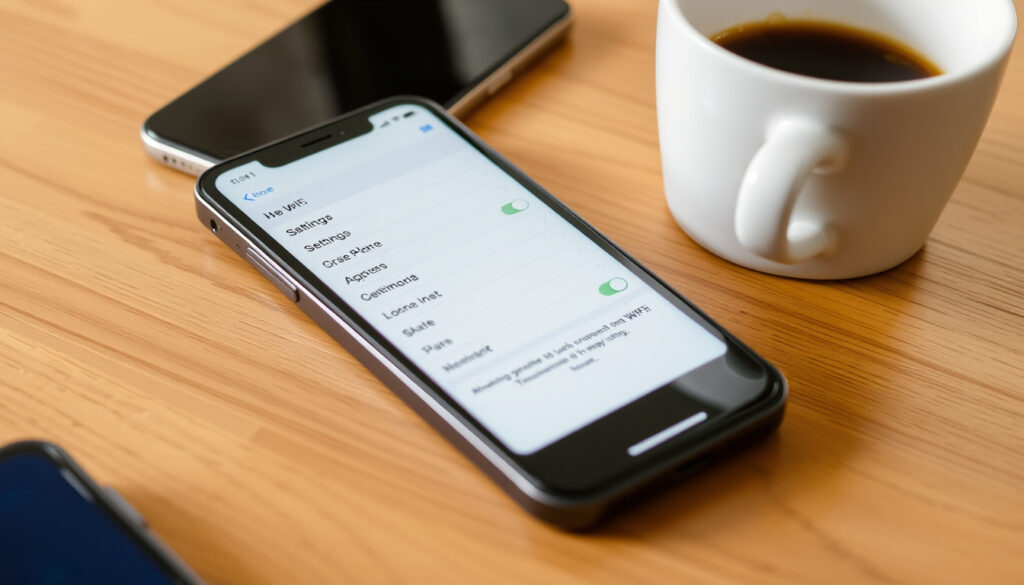
Share Wi-Fi Password from iPhone: Complete How-To Guide
Few things are as awkward as standing in someone’s hallway, phone in hand, trying to explain your Wi-Fi password while they squint at a tiny screen. Apple made that moment smoother back in 2017 with a native handshake feature in iOS 11, but it only works between Apple devices that know each other.
Introduced in iOS version: iOS 11 (2017) ·
Native sharing requires both devices to have: Apple ID contacts saved ·
Distance limit for native sharing: Within Bluetooth range (~10 meters) ·
Alternative method: QR code: Available via Shortcuts or third-party apps ·
Manual password location: Settings > Wi-Fi > Info (i) icon
Quick snapshot
- Native sharing works between Apple devices with iOS 11+/macOS High Sierra+ (Apple Support)
- QR code sharing requires iOS 17 or later or third-party app (T-Mobile)
- Password visible in plain text in iOS 16+ Settings (YouTube Tutorial)
- Sharing to Android requires QR or manual password (T-Mobile)
- Which third-party apps are safe and respect privacy
- Exact distance limit for Bluetooth handshake in practice
- Compatibility with very old iOS versions (e.g., iOS 10)
- iOS 11 (2017): Native proximity sharing introduced (Apple Support)
- iOS 16 (2022): Plain-text password view added (YouTube Tutorial)
- iOS 17 (2023): QR code generation in Passwords app (T-Mobile)
- macOS Ventura (2022): Full iPhone QR compatibility (T-Mobile)
- More cross-platform sharing options expected in future iOS versions
- Third-party apps will likely add passwordless sharing via QR
- Android Nearby Share may expand to iOS
The table below summarizes the key version milestones and requirements for Wi‑Fi password sharing on iPhone.
| Fact | Value |
|---|---|
| Native sharing introduced | iOS 11, 2017 |
| iOS version for plain text password view | iOS 16 (2022) |
| Apple ID needed for native sharing | Yes (both must be in Contacts) |
| Maximum devices per share | One at a time via handshake |
| QR code generation built-in | iOS 17+ in Passwords app |
| Bluetooth required for proximity sharing | Yes, both devices |
How do I share my Wi‑Fi password on my iPhone?
Prerequisites for native sharing
- Both devices must be running iOS 11 or later (Apple Support, the device maker’s official guide).
- The Apple ID email or phone number of the recipient must be in your Contacts (OWC MacSales, a Mac accessory retailer).
- Bluetooth and Wi‑Fi must be enabled on both devices (EPB, a US broadband provider).
- Personal Hotspot must be turned off on both iPhones (OWC MacSales).
Step-by-step: Share password with another Apple device
- Make sure you are connected to the Wi‑Fi network you want to share (Apple Support).
- On the guest device, go to Settings > Wi‑Fi and tap the network name.
- On your iPhone, a notification will appear: “Share Password”. Tap it.
- Complete the authentication with Face ID or Touch ID (EPB).
- The password is sent automatically; the guest connects instantly.
What to do if the share prompt doesn’t appear
- Check that Bluetooth is on and both devices are within about 10 meters (JNA Dealer Program, a community forum).
- Ensure both devices have the latest iOS updates (JNA Dealer Program).
- Restart Wi‑Fi on both devices.
- If still failing, manually read the password from Settings > Wi‑Fi > (i) after authenticating.
Native sharing is the fastest method for Apple-to-Apple, but it fails silently when prerequisites aren’t met. The most common culprit: the recipient’s Apple ID isn’t saved as a contact — double-check before assuming the feature is broken.
The implication: Getting the prerequisites right before attempting native sharing prevents the most common failure points.
How to share Wi‑Fi to another device?
Using QR code from iPhone
- iOS 17+: Go to Settings > Passwords > Wi‑Fi, tap the network, then tap Show QR Code (Apple Support).
- Older iOS: Use the Shortcuts app or a third-party app like WiFi Pass to generate a QR code.
- Any device with a camera — Android, Windows, TV — can scan the code and connect without typing (T-Mobile, a mobile carrier).
Manually reading the password aloud
If QR isn’t an option, the fallback is manual: Settings > Wi‑Fi > tap (i) next to your network > Password — then authenticate with Face ID or Touch ID. The password appears in plain text. Read it out, or type it for the other person (YouTube Tutorial).
Third-party apps for cross-platform sharing
- Apps like WiFi Pass or QR Code Generator can create a shareable image or text message.
- Some store multiple networks for quick access — but privacy policies vary. Check app permissions before use.
- Android users can use Nearby Share: Quick Settings > Nearby Share > Share network from active Wi‑Fi (T-Mobile).
The pattern: QR codes bridge the cross-platform gap that native sharing cannot address alone.
How to share your Wi‑Fi password from your iPhone or iPad?
Sharing from iPhone to iPad
Same-iCloud-account devices share passwords automatically via iCloud Keychain — no handshake needed. If different Apple IDs, use the native proximity sharing (described above) as long as each is in the other’s Contacts (EPB).
Sharing from iPhone to Mac
Mac requires macOS High Sierra (2017) or later for native sharing. If you’re signed into the same Apple ID on both devices, sharing happens without a contact requirement (EPB). For different Apple IDs, the recipient must be in your Contacts. Alternatively, macOS Ventura or later supports QR code scanning for iPhone-generated QR codes (T-Mobile).
Using iCloud Keychain to auto-share across devices
When all devices use the same Apple ID, iCloud Keychain syncs saved Wi‑Fi passwords silently. New devices signed into the same iCloud account automatically get access — no sharing step required. For family members, use iCloud Family Sharing to share keychain entries.
The convenience of iCloud Keychain is that it’s invisible — but it only works within your own Apple ecosystem. Sharing with a friend’s Mac requires the contact handshake, which many users don’t realize needs a pre-saved contact entry.
What this means: iCloud Keychain’s seamless sync stops at the boundary of your own Apple ID, making the contact handshake the necessary bridge for sharing with others.
How do I share Passwords between Apple devices?
Using AirDrop to share passwords
In iOS 18+, the Passwords app allows sharing individual entries (including Wi‑Fi) via AirDrop. Open Settings > Passwords, tap a network, select Share, and choose a nearby device (Apple Support). AirDrop works even without the recipient being in your Contacts.
Using iCloud Keychain for passwords
iCloud Keychain syncs all passwords — Wi‑Fi, websites, apps — across devices signed into the same Apple ID. It’s the most seamless method for personal use, but it doesn’t share with others unless you use Family Sharing or manually share an entry.
Password sharing limitations
- Not all passwords can be shared; Wi‑Fi passwords are explicitly shareable.
- Sharing requires devices to be nearby (Bluetooth range) or on the same iCloud account.
- You cannot share a password to a device running iOS 10 or older (JNA Dealer Program).
What this means: Apple’s password sharing tools are powerful within the ecosystem but have clear boundaries that users need to understand before troubleshooting.
Does the iPhone have a Wi‑Fi sharing option?
Native Wi‑Fi sharing (Apple-only)
Yes — the built-in proximity sharing is an Apple‑only feature. It does not appear as a menu option; it triggers automatically when a known contact taps the Wi‑Fi network on a nearby device (Apple Support).
QR code generation
Starting with iOS 17, Apple added a QR code generator inside the Passwords app. For earlier versions, you need a third‑party app or the Shortcuts automation tool.
Manual password retrieval
The Wi‑Fi password can be viewed in plain text since iOS 16 (YouTube Tutorial). This is the universal fallback for any device.
The implication: Each sharing method serves a specific context, and knowing which to use eliminates the friction of a failed handshake.
What’s confirmed vs what’s still unclear
Confirmed facts
- Native sharing works between Apple devices with iOS 11+/macOS High Sierra+
- QR code sharing requires third-party app or Shortcuts (built-in from iOS 17)
- Password can be viewed in iOS 16+ Settings under Wi‑Fi info
- Sharing to Android requires QR or manual password
What’s unclear
- Which third-party apps are safe and respect privacy
- Exact distance limit for Bluetooth handshake in practice
- Compatibility with very old iOS versions (e.g., iOS 10)
What users and experts say
“Ask the person requesting the password to tap the Wi‑Fi network name on their device. When the share prompt appears on your iPhone, tap Share Password. Your iPhone then authenticates with Face ID or Touch ID and sends the password.”
— Apple Support, official device documentation (Apple Support)
“For Android users, the easiest way is to scan a QR code. On a Samsung phone, you can also use Quick Settings > Nearby Share to share the network — but it only works between Android devices.”
— T-Mobile, US carrier support guide (T-Mobile)
The takeaway: Apple’s ecosystem makes sharing effortless for its own devices, but the moment a guest pulls out an Android phone or a Windows laptop, you need a different tool. QR codes bridge that gap neatly, and the built‑in password viewer is always there as a last resort. For anyone juggling a household with mixed devices, generating a QR code once and keeping it accessible saves repeated hassle.
Frequently asked questions
Can I share my Wi‑Fi password from iPhone without using Face ID?
Yes — you can view the password in Settings > Wi‑Fi > (i) > Password, then authenticate with your passcode instead of Face ID. Or generate a QR code in the Passwords app (iOS 17+) which doesn’t require biometric authentication to display.
Is it safe to use a QR code to share my Wi‑Fi password?
Generally yes, because the QR code does not expose the password in readable text unless someone saves the image and decodes it. However, anyone with a QR scanner can immediately join the network. Only share QR codes with trusted people, and regenerate the password if you suspect misuse.
How do I share my Wi‑Fi password with someone who is not in my Contacts?
Use the QR code method (iOS 17+ Passwords app or a third-party app) or manually read the password from Settings > Wi‑Fi > (i). Without a contact entry, the native proximity sharing prompt will not appear.
Why does the share prompt not appear on my iPhone?
Common causes: Personal Hotspot is turned on, Bluetooth is off, the recipient isn’t in your Contacts, or one device is on an older iOS version. Ensure both devices are near each other and connected to the same network.
Can I share my Wi‑Fi password from iPhone to an Apple Watch?
Yes — when an Apple Watch tries to join a known Wi‑Fi network, the paired iPhone can share the password automatically via iCloud Keychain. No manual sharing needed; it happens in the background.
Does sharing Wi‑Fi password from iPhone work with a guest network?
Yes — the same methods work for guest networks as long as the guest Wi‑Fi is saved on your iPhone. If the guest network requires a portal login, you may need to share that login separately.
How do I stop sharing my Wi‑Fi password after sharing?
You cannot revoke a shared password after the fact. The recipient’s device stores the password permanently. To revoke access, change your Wi‑Fi network password on the router.
Related reading
- YouTube to MP4 Converter: Free, Safe Tools Compared (2025) — a tech how‑to guide for file conversion
- Redmi Note 10 Pro – Specs Price Review 2025 — smartphone review with connectivity details
More related posts
 Green Party Leader UK and Ireland: Current and Past Leaders
 Nick Pope Injury: Latest News on Newcastle Goalkeeper
 Lucy Beaumont: Biography, Split, Tour, and TV Shows
 Wilfried Nancy’s 33-day Celtic tenure: Why he was sacked
 Frank Skinner: Wife, Net Worth, Sobriety, and Fatherhood
 Royal Challengers Bengaluru vs Mumbai Indians IPL 2026 Scorecard
 Elton John Health & Family: Diagnosis, Wheelchair, Wife, Kids (2025)
 BMW 3 Series for Sale in Ireland – Used Cars Near Me