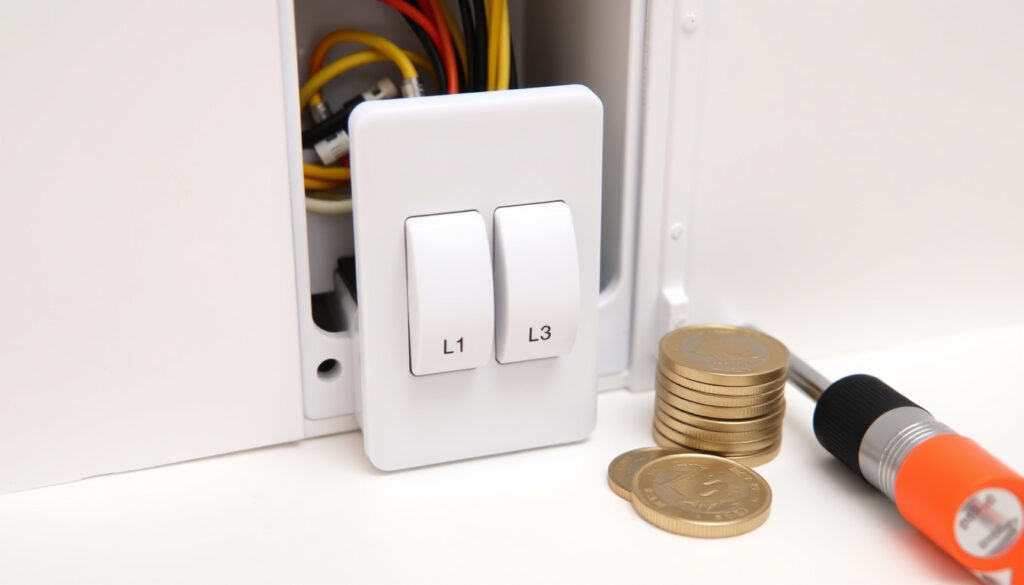
Lighting Switch Guide: Types, Wiring (L1 L2 L3) & Ireland Costs
If you’ve ever stared at the back of a light switch and wondered what L1, L2, and L3 actually mean, you’re not alone. This guide walks through the four main types of lighting switches, explains those cryptic terminal markings, and gives you a clear picture of what it costs to get a switch replaced in Ireland — whether you do it yourself or call an electrician.
Typical cost to replace a light switch (2026): €15–€50 (electrician labor plus part) ·
Common types in Irish homes: 4–6 (one-way, two-way, intermediate, dimmer, pull-cord, smart) ·
Average time for DIY switch replacement: 15–30 minutes per switch ·
Electrician hourly rate in Ireland (2025): €40–€70 per hour
Quick snapshot
- One-way switches are the simplest and most common type (Pro Certs Software (electrical training provider))
- L1, L2, L3 markings are used on many European light switches for multi-way wiring (Socket Store (UK electrical retailer))
- In Ireland, new circuits require a registered electrician (RECI) (ESB Networks (Ireland’s electricity distribution operator))
- Exact cost of electrician in 2026 varies by region and complexity
- Specific terminal labeling can differ between manufacturers
- Some older wiring may not conform to current color codes
- No timeline data available for this topic
- Check your existing switch terminals before buying a replacement
- Decide whether DIY or professional installation fits your skill level
- Match switch type to your home’s wiring configuration
The table below summarises the essential details.
| Label | Value |
|---|---|
| Number of switch types covered in guide | 4 main types (one-way, two-way, intermediate, dimmer) |
| Typical electrician cost in Ireland (2025) | €40–€70 per hour + €5–€15 for basic switch |
| Common terminal markings (EU) | L1, L2, L3 (may also be COM, L1, L2 on some brands) |
| DIY difficulty rating | Easy to moderate (requires basic electrical knowledge) |
What are the 4 types of lighting switches?
Four main switch types cover nearly every domestic lighting setup in Ireland. The right one depends on how many locations need to control a light and whether you want dimming capability.
One-way (single-pole) switch
- Controls a light from one location only — the simplest and most common domestic switch (Pro Certs Software (electrical training provider))
- Uses COM (live in) and L1 (switched live out); L2 is left unused (Pro Certs Software)
- Found in bedrooms, living rooms, and any room with a single entry point
Two-way switch
- Controls a single light from two separate locations — ideal for hallways and staircases (Pro Certs Software)
- Uses L1 and L2 as strapper (traveller) terminals between the two switches (Pro Certs Software)
- Requires two switches wired in a matched pair — one at each end of a hallway or staircase
Intermediate switch
- Adds a third (or more) control point between two two-way switches (Socket Store (UK electrical retailer))
- Uses L1, L2, L3, and L4 terminals to cross-connect traveller wires (Socket Store)
- Common in long hallways, large rooms with multiple entrances, or staircases with a landing
Dimmer switch
- Adjusts brightness levels — requires compatible LED or incandescent bulbs (GE Lighting (lighting manufacturer))
- Often includes a rotary knob, slider, or touch control
- Not all dimmers work with all bulb types; check compatibility before purchase
A dimmer switch gives you ambiance control, but it demands bulb compatibility. Pair an old dimmer with modern LEDs and you risk flickering or reduced lifespan. Always check the dimmer’s minimum load rating.
The pattern across all four types: the more control points you want, the more terminals you need. One-way switches use just COM and L1. Two-way adds L2. Intermediate switches bring in L3 and L4. The complexity scales with convenience.
What does L1, L2, and L3 mean on a light switch?
Those letters stamped into the back of a switch aren’t random — they’re a standardised labelling system used across European wiring conventions. But here’s where it gets tricky: L1, L2, and L3 on a light switch mean something different from the L1, L2, L3 used in Irish three-phase supply wiring.
L1 terminal: load or live out
- In a one-way switch, L1 is the terminal that sends switched live to the lamp (Pro Certs Software)
- On some brands, this terminal may be labelled “L” or “1” instead of L1
- Always the output side — the wire that carries power to the light when the switch is on
L2 terminal: second live (two-way wiring)
- Used as a strapper (traveller) terminal in two-way switching setups (Pro Certs Software)
- Connects to the L2 terminal on the paired switch at the other location
- It doesn’t matter which strapper goes to L1 and which to L2, as long as both switches are wired consistently (Socket Store)
L3 terminal: third live (intermediate switching)
- Found on intermediate switches that sit between two two-way switches (Socket Store)
- Intermediate switches typically have four terminals (L1, L2, L3, L4) that cross-connect the traveller pairs
- L3 and L4 form the second traveller pair in a multi-way circuit
Don’t confuse switch-terminal L1/L2/L3 with the Irish three-phase supply colours. Stamford Electrical, an Irish electrical supplier, warns that L1, L2, and L3 in supply wiring refer to brown, black, and grey phase conductors — a completely different system used in industrial installations, not domestic switch circuits.
Do I need an electrician to install a light switch?
In Ireland, the answer depends on what you’re doing. Replacing an existing switch like-for-like is generally fine for a competent DIYer. Running new circuits or adding new points? That’s a job for a registered electrician.
Legal requirements in Ireland
- Minor electrical work like replacing a switch can be done by a competent DIYer under Irish regulations
- New circuits or additions to existing circuits must be carried out by a registered electrician (RECI) (ESB Networks (Ireland’s electricity distribution operator))
- ESB Networks has sole responsibility for providing customer connections to the distribution system — an individual may not provide an electrical connection (ESB Networks)
When DIY is safe
- Replacing a faulty switch with an identical type (one-way for one-way, two-way for two-way)
- Upgrading a standard switch to a dimmer, provided the wiring configuration matches
- You have basic electrical knowledge and can safely isolate the circuit at the breaker
When professional installation is required
- Adding a new switch where none existed before (new circuit)
- Converting a one-way setup to two-way or intermediate switching
- Any work in a kitchen, bathroom, or outdoors where special regulations apply
- If you’re unsure about the wiring — always consult a registered electrician
Average electrician cost to fit a light switch in Ireland: €15–€50, including the part and labour for a straightforward replacement. The hourly rate typically runs €40–€70 (Checkatrade (UK trade directory)).
For most homeowners, the rule is simple: swap like-for-like yourself, leave new circuits to the pros.
How do I tell what type of light switch I need?
Choosing the right switch comes down to three questions: how many places control the light, what kind of bulbs you’re using, and what your existing wiring looks like.
Check existing wiring configuration
- Count the number of locations that control the light
- One location → one-way switch
- Two locations → two-way switches
- Three or more locations → intermediate switch between two two-way switches
Identify number of control points
- Walk to each switch that controls the same light and note how many there are
- If you have switches at both ends of a hallway, you need two-way switches
- If there’s a third switch on a landing, that’s an intermediate switch
Match switch type to electrical load
- Dimmer requires compatible LED or incandescent bulbs — check the dimmer’s load rating (GE Lighting)
- Standard switches work with any bulb type but offer no dimming
- Smart switches may require a neutral wire at the switch box — not all Irish homes have one
Why this matters: buying the wrong switch type means either a return trip to the hardware store or, worse, a non-functional circuit. Match the switch to the number of control points first, then check bulb compatibility.
How to wire a light switch L1, L2, and L3?
Wiring a light switch is straightforward if you follow the terminal markings. The key rule: power off at the breaker, test for dead, then connect.
- Step 1: Turn off power at the circuit breaker
- Switch off the relevant circuit at the consumer unit (fuse box) (Screwfix (UK hardware retailer))
- Use a voltage tester to confirm power is off before touching any wires (Screwfix)
- GE Lighting’s DIY guide also emphasises testing both switches before work begins (GE Lighting)
- Step 2: Identify the wires
- Brown wire: live (phase) conductor — connects to COM terminal (Screwfix)
- Blue wire: neutral — if used as switched live, it must be sleeved brown to indicate it’s a live conductor (Screwfix)
- Green/yellow wire: earth (ground) — connects to the earth terminal on the switch backbox
- Step 3: Connect wires to correct terminals
- One-way switch: live to COM, switched live to L1 (Pro Certs Software)
- Two-way switch: live to COM on first switch, L1 to L1 and L2 to L2 between the two switches (Pro Certs Software)
- Intermediate switch: traveller wires from first two-way switch connect to L1/L2, traveller wires to second two-way switch connect to L3/L4 (Socket Store)
- Step 4: Secure and test
- Tighten terminal screws firmly — loose connections cause arcing and heat
- Gently tug each wire to confirm it’s secure
- Restore power and test the switch before screwing the faceplate back on
For a DIYer replacing a one-way switch, the wiring is as simple as two connections: COM and L1. Two-way and intermediate setups add complexity but follow a logical pattern — traveller wires pair up across switches. If the terminal labels don’t match your switch, refer to the manufacturer’s wiring diagram.
Comparison: Light switch types at a glance
Four switch types, one pattern: the more control points you need, the more terminals you use.
| Switch type | Control points | Terminals used | Best for |
|---|---|---|---|
| One-way | 1 | COM, L1 | Bedrooms, living rooms, single-entry rooms |
| Two-way | 2 | COM, L1, L2 | Hallways, staircases, rooms with two entrances |
| Intermediate | 3+ | L1, L2, L3, L4 | Long hallways, landings, large rooms |
| Dimmer | 1+ | COM, L1 (plus neutral on some models) | Living rooms, dining rooms, mood lighting |
The pattern: one-way is the simplest and cheapest. Two-way adds convenience at the cost of an extra switch and more wiring. Intermediate scales to any number of control points. Dimmer trades simplicity for ambiance.
Pros and cons of DIY light switch installation
Upsides
- Save €40–€70 per hour on electrician labour
- Simple one-way replacement takes 15–30 minutes
- No need to schedule a tradesperson — do it on your own time
- Satisfaction of a completed home improvement task
Downsides
- Risk of incorrect wiring if terminal markings are misunderstood
- No professional liability if something goes wrong
- May not comply with Irish wiring regulations for new circuits
- Requires basic tools: voltage tester, screwdriver, wire strippers
The decision to DIY or hire depends on your confidence and the complexity of the job.
Related reading: Best Water Bottles 2026: Health, Trends & Irish Brands · Ladies Coats – Where to Buy, Styles & Tips
esbnetworks.ie, facebook.com, youtube.com, esbnetworksprdsastd01.blob.core.windows.net, stamfordelectrical.ie, youtube.com, youtube.com
Frequently asked questions
What is the difference between L1, L2, and L3 on a light switch?
L1 is the switched live output to the lamp. L2 is a strapper terminal used in two-way switching. L3 (and L4) are used on intermediate switches for multi-way control. These are switch terminals, not supply phases — a common point of confusion.
Can I use a dimmer switch with LED bulbs?
Yes, but only if the dimmer is specifically rated for LED loads. Many older dimmers are designed for incandescent bulbs and may cause flickering or reduced bulb life with LEDs. Check the dimmer’s minimum load rating and compatibility list.
How do I know if my light switch is faulty?
Signs include: the light flickers when the switch is on, the switch feels warm to the touch, it makes a crackling sound, or the light doesn’t turn on at all. A faulty switch should be replaced promptly — it can be a fire risk.
What should I do if my light switch feels hot?
A hot switch indicates a loose connection or an overloaded circuit. Turn off the power at the breaker immediately and inspect the wiring. If you’re not comfortable doing this, call a registered electrician. Do not use the switch until the issue is resolved.
Is it safe to replace a light switch without turning off the power?
No. Always switch off the power at the circuit breaker and use a voltage tester to confirm the circuit is dead before touching any wires. Working on live circuits is extremely dangerous and can cause electric shock or death.
Do I need a special switch for a ceiling fan?
Ceiling fans typically use a standard one-way or two-way switch for the fan motor, plus a separate switch for the light kit if fitted. Some fans use a pull-chain for speed control. Always check the fan’s wiring diagram before connecting.
How often should light switches be replaced?
Light switches don’t have a set replacement interval. Replace them when they show signs of wear: cracks in the faceplate, stiffness in the toggle, discolouration, or if they feel warm. Modern switches can last decades under normal use.
For Irish homeowners, the choice between DIY and professional installation is clear: replace like-for-like yourself, but call a RECI-registered electrician for anything that involves new circuits or changes to the wiring configuration. A voltage tester and a basic understanding of L1, L2, and L3 terminals are all you need for a safe, successful swap.
More related posts
 Hula Hoop Workout: Weight Loss, Calories, and Belly Fat Facts
 Levante UD vs FC Barcelona Lineups – Confirmed Starting XI
 Steven Pressley: Player, Manager, and Dundee Head Coach
 Anne Frank: Her Diary, Life in Hiding, and Holocaust Legacy
 Royal Challengers Bengaluru vs Mumbai Indians IPL 2026 Scorecard
 New Zealand vs West Indies: Head-to-Head Record & 2025 Tour Guide
 Lord of the Flies – Summary Characters Themes Analysis
 Vanessa Williams: Miss America to chart-topping singer