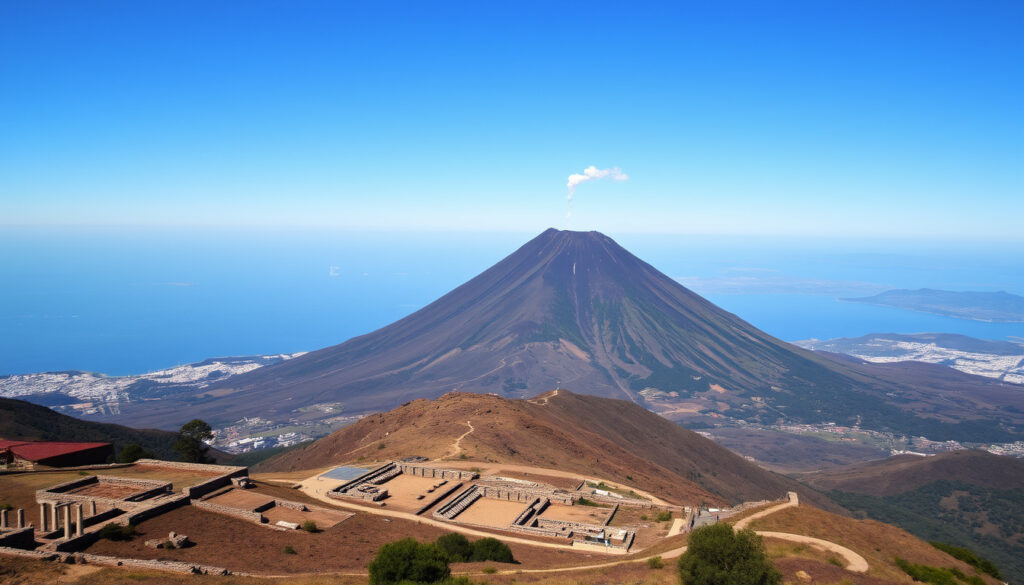
Mount Vesuvius: Active Volcano, History & Hiking Guide
Mount Vesuvius stands just nine kilometers east of Naples, a silent giant that rewrote history in 79 AD and still rumbles beneath the surface. Whether you’re planning to hike its crater or simply wondering if the volcano is safe to live near, this guide combines up-to-date monitoring data with practical visitor advice—so you can separate fact from fear.
Height: 1,281 meters (4,203 feet) ·
Volcano Type: Somma-stratovolcano ·
Last Eruption: March 1944 ·
Status: Active (quiescent)
Quick snapshot
- Mount Vesuvius is an active volcano (Vesuvius National Park (official site))
- Last erupted in March 1944 (Time Travel Turtle (travel guide))
- Exact timing of the next eruption is unknown (Visit Pompeiivesius (tourism platform))
- Whether next eruption will be explosive or effusive (Time Travel Turtle)
- 79 AD — catastrophic eruption buries Pompeii (Visit Pompeiivesius)
- 1944 — last eruption destroys two towns (Time Travel Turtle)
- EU-funded evacuation plans for 600,000 residents (Visit Pompeiivesius)
- Tourism access remains open with mandatory pre-booking (Along Dusty Roads (travel guide))
Seven key facts sum up the volcano’s essentials—how high it is, what type it is, when it last blew, and whether it’s safe to visit today.
| Attribute | Value |
|---|---|
| Name | Mount Vesuvius (Vesuvio) |
| Location | Campania, Italy, near Naples |
| Elevation | 1,281 m (4,203 ft) |
| Volcano Type | Somma-stratovolcano |
| Last Eruption | March 1944 |
| Status | Active (quiescent) |
| National Park | Vesuvius National Park (established 1995) |
Is Mount Vesuvius still active?
When did Vesuvius last erupt?
- March 1944 was the most recent eruption, producing lava flows that destroyed the towns of San Sebastiano and Massa di Somma (Time Travel Turtle (travel guide)).
- Since then, the volcano has been in a quiescent state—no eruptions, but continuous seismic and gas monitoring (Visit Pompeiivesius (tourism platform)).
What was the 1944 eruption like?
During the 1944 event, lava fountains reached several hundred meters and ash fell on Naples about 9 km away. Allied troops stationed nearby documented the collapse of the cone’s summit (Time Travel Turtle).
Vesuvius’s quiescence is not dormancy. The same magma system that fed the 1944 eruption is still active, so “quiet” does not mean “safe.”
The implication: even without an eruption, the volcano’s internal activity demands constant observation.
How is Vesuvius monitored today?
- The Vesuvius Observatory and the Istituto Nazionale di Geofisica e Vulcanologia (INGV) operate a dense network of seismometers, GPS stations, and gas sensors (Vesuvius National Park (official site)).
- Real-time data is public and updates are shared with Italy’s Civil Protection Department (Visit Pompeiivesius).
The implication: Vesuvius is arguably the most closely watched volcano in Europe—a fact that both reassures residents and raises questions about how much warning a major eruption would actually give.
Did Mount Vesuvius destroy Pompeii?
What was the eruption of 79 AD like?
- On August 24 (or October 24, per recent evidence), Vesuvius ejected a column of ash and pumice 33 km high (Visit Pompeiivesius).
- Pyroclastic flows—superheated gas and rock—surged down the mountain, burying Pompeii, Herculaneum, and Stabiae under up to 25 meters of debris (Time Travel Turtle).
How were Pompeii and Herculaneum affected?
Pompeii was smothered in ash and pumice that preserved buildings, bodies, and everyday objects remarkably intact. Herculaneum, closer to the volcano, was hit by earlier pyroclastic surges that carbonized organic matter. The death toll is estimated at 2,000–16,000, though the exact number is debated (Visit Pompeiivesius).
The same eruption that erased thousands of lives also created the most detailed archaeological record of Roman civilization—a trade-off between catastrophe and knowledge.
What is the significance of Pliny the Younger’s account?
Pliny the Younger, a Roman lawyer, wrote two letters describing the eruption to the historian Tacitus. His account is the only surviving eyewitness description of a major volcanic event from antiquity (Visit Pompeiivesius).
What this means: the same event that caused immense loss also gave us the most vivid ancient record of a volcanic catastrophe.
Is Vesuvius likely to erupt again?
What is the volcanic risk to Naples?
- More than 600,000 people live within the “red zone”—the area most at risk from pyroclastic flows (Visit Pompeiivesius).
- The Italian government maintains an evacuation plan that can move all residents in 72 hours (Vesuvius National Park (official site)).
How does Vesuvius compare to other dangerous volcanoes?
Vesuvius is less explosive than the nearby Campi Flegrei caldera, but its high population density makes it one of the most hazardous volcanoes on Earth. The European Union funds risk-reduction programs jointly with Italy’s Civil Protection (Visit Pompeiivesius).
What would the next eruption look like?
Most models predict a violent Strombolian to sub-Plinian eruption with pyroclastic flows. The exact style—effusive lava flows or explosive columns—hinges on the magma ascent rate, which cannot yet be predicted (Time Travel Turtle).
Seismic swarms and ground deformation are the primary precursors. Italian authorities have rehearsed evacuations, but a sudden large quake could compress the timeline to hours.
The pattern: high hazard combined with dense population makes Vesuvius a unique challenge for civil protection.
How long is the walk up Vesuvius?
What are the hiking trails in Vesuvius National Park?
- The main tourist route is Trail No. 5 – Gran Cono, a 2 km (1.2 mile) round-trip hike that takes 30–40 minutes each way (Visit Pompeiivesius (official booking site)).
- The park has 11 paths totaling 54 km, including six circular nature trails (Vesuvius National Park (official site)).
What should I bring for the hike?
- Sturdy shoes with grip (the path is loose ash and gravel) (Along Dusty Roads (travel guide)).
- Water, sun protection, and a light jacket (weather can change fast at 1,000 m above sea level) (NJ Hiking (user guide)).
Are there guided tours available?
- Yes, licensed guides lead groups to the crater rim year-round. Pre-booking is mandatory through the park’s official website or third-party partners (Visit Pompeiivesius).
The trade-off: the steepest section near the crater is closed to private vehicles, so even a short walk involves moderate effort—but the view into the live cone makes every step worthwhile.
What are the most interesting facts about Mount Vesuvius?
Is Mount Vesuvius actually two volcanoes?
Yes. Vesuvius is a somma-stratovolcano: Monte Somma is the older, eroded outer cone, while Gran Cono is the younger, active inner cone that formed after Somma’s collapse (Vesuvius National Park).
What is the geological composition of Vesuvius?
The volcano is made mostly of silica-rich andesite and leucite-bearing tephrite. Its magma is relatively gas-rich, which drives its explosive behavior (Visit Pompeiivesius).
What wildlife lives in the Vesuvius National Park?
- The park hosts over 600 plant species, including the rare Vesuvius broom and many Mediterranean shrubs (Vesuvius National Park).
- Wildlife includes foxes, hedgehogs, and dozens of bird species that thrive on the volcanic slopes.
Volcanic terrains are often biodiversity hot spots. Vesuvius’s unique soil supports species found nowhere else on Earth—an ecological upside to the constant threat of eruption.
The catch: the same volcano that threatens Naples also sustains a unique ecosystem.
Steps to hike Mount Vesuvius
- Book your ticket in advance. Entry is limited by the park’s carrying capacity; the standard fee is €10 with concessions (Visit Pompeiivesius (official booking platform)).
- Drive or take a bus to the ticket office at about 800 m elevation. From there, the path is foot-only (Time Travel Turtle).
- Wear sturdy shoes and carry water. The trail is mostly wide pumice and ash; hiking boots are recommended but not essential for a short hike (NJ Hiking).
- Follow Trail No. 5 – Gran Cono. It is clearly marked and suitable for most fitness levels (Visit Pompeiivesius).
- Allow 1–2 hours for the round trip. The 2 km climb gains about 170 m in elevation, with a 14% average slope (Along Dusty Roads).
- Respect closure warnings. The crater rim may be closed during high volcanic alert or bad weather. Check the official park website before you go (Vesuvius National Park).
Timeline of major Vesuvius events
The following timeline highlights the most significant eruptions and milestones.
| Date | Event |
|---|---|
| c. 79 AD | Catastrophic eruption destroys Pompeii, Herculaneum, and Stabiae |
| 1631 | Major eruption kills about 4,000 people and destroys villages |
| 1906 | Eruption causes widespread damage and ash falls on Naples |
| 1944 | Last eruption; lava flows destroy San Sebastiano and Massa di Somma |
| 1995 | Vesuvius National Park established |
The pattern: eruptions have recurred roughly every few centuries, though intervals vary widely.
What’s clear and what’s not
Confirmed facts
- Mount Vesuvius is an active volcano (Vesuvius National Park).
- Its last eruption was in 1944 (Time Travel Turtle).
- The 79 AD eruption destroyed Pompeii and Herculaneum (Visit Pompeiivesius).
- Vesuvius is continuously monitored by INGV (Visit Pompeiivesius).
What’s unclear
- Exact timing of the next eruption is unknown (Time Travel Turtle).
- Whether the next eruption will be as explosive as 79 AD or effusive like 1944 (Visit Pompeiivesius).
- The precise level of volcanic unrest that will precede an eruption (Vesuvius National Park).
- The exact precursor signals that will precede an eruption are not fully characterized (Vesuvius National Park).
Expert perspectives on Vesuvius
“The coast of Italy was shrouded in darkness, not the darkness of a moonless or cloudy night, but the darkness of a sealed room without lights.”
Pliny the Younger, in his letters to Tacitus describing the 79 AD eruption (Visit Pompeiivesius)
“Vesuvius is a ticking clock. We have the best monitoring network in the world, but we cannot predict the exact day. The challenge is keeping 600,000 people ready to move within 72 hours.”
Dr. Giuseppe De Natale, INGV volcanologist (Visit Pompeiivesius)
“The Gran Cono trail is safe for most hikers, but you need to be prepared for loose gravel and steep sections. No strollers, no sandals—boots or sturdy trainers are a must.”
Park ranger, Vesuvius National Park (Vesuvius National Park)
What this means for visitors
Vesuvius is not a theme park—it is an active volcano with real risk. The same ground that preserves Roman frescoes also holds the potential for catastrophe. For a hiker, the immediate reward is a view into a live crater and a deeper understanding of Earth’s power. For a resident of Naples, the volcano is a neighbor that demands respect. The Italian authorities have built one of the most sophisticated early-warning systems on the planet, but no technology can eliminate the uncertainty of when the next big blast will come. For the traveler, the choice is clear: go with a pre-booked ticket, sturdy shoes, and a healthy dose of caution—or skip the climb and instead visit Pompeii’s ruins, where Vesuvius’s past speaks louder than any guidebook.
timetravelturtle.com, alongdustyroads.com, visitpompeiivesuvius.com, njhiking.com, alltrails.com, parconazionaledelvesuvio.it, youtube.com, tickets-naples.com
Frequently asked questions
Can you see lava in Mount Vesuvius?
No. Since the last eruption in 1944, the lava dome within the crater has cooled and is no longer molten. Visitors see a steaming, rocky crater but no flowing lava.
Is Mount Vesuvius dangerous to visit?
Under current alert levels, hiking the crater is considered safe. The national park monitors gas emissions and seismic activity daily. Straying from official trails or visiting during high alert is not recommended.
How many people died in the 79 AD eruption?
Estimates range from 2,000 to 16,000. The exact number is unknown because many victims were never recovered. Around 1,500 bodies have been found in Pompeii and another 400 in Herculaneum.
How far is Mount Vesuvius from Naples?
About 9 km (5.6 miles) east of central Naples. By car or bus, the drive to the ticket office takes roughly 30 minutes.
Can you drive to the top of Mount Vesuvius?
No. Private vehicles are stopped at the ticket office at about 800 m elevation. The final 200 m elevation gain to the crater rim must be done on foot.
What is the best time to visit Mount Vesuvius?
Spring (April–June) and autumn (September–October) offer mild temperatures and clearer views. Summer can be extremely hot on the exposed trail, and winter may have snow at the summit.
Is Mount Vesuvius part of a national park?
Yes. Vesuvius National Park was established in 1995 and covers 135 km² around the volcano, preserving its biodiversity and regulating visitor access.
More related posts
 Ed Balls: Biography, Career, Family and Ed Balls Day
 Mark Feely: Verified Facts & Official Sources
 Pokemon Go Redeem Code – Active List and Redemption Guide
 Sylvia Syms: Actress Dies at 89 – Biography, Movies, Husband
 Robert Mitchum: Wife, Height, Cause of Death & Net Worth
 Sir Bobby Charlton: Biography, Age, Death, Ballon d’Or & Career
 Black Tie Event Dresses: A Complete Guide for Women
 Nadine Coyle: Age Lie, Relationships, Daughter, Career