London Natural History Museum – Complete Visitor Guide
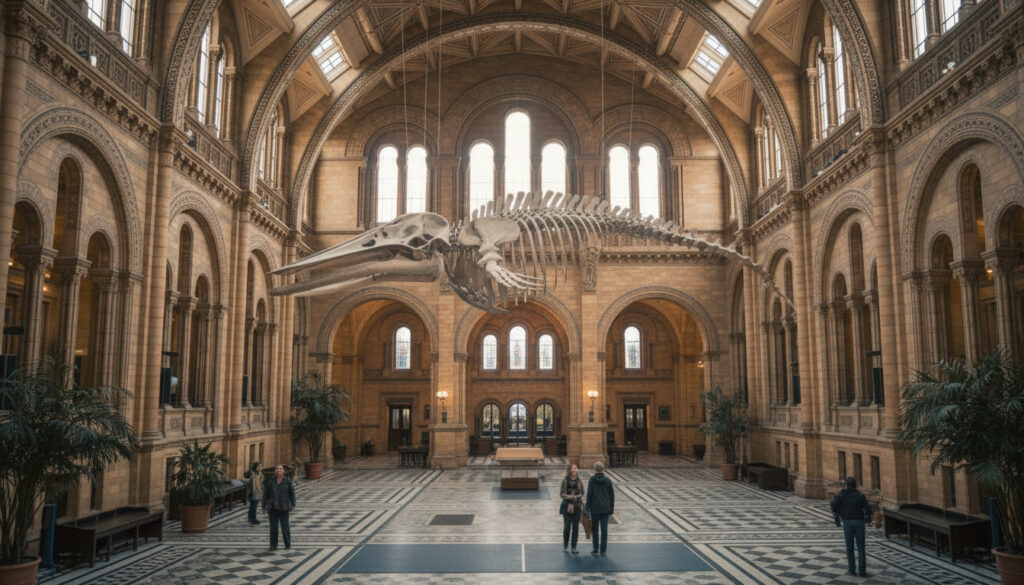
The Natural History Museum London stands among the world’s premier institutions for scientific research and public engagement, housing more than 80 million specimens within its terracotta-clad walls on Cromwell Road in South Kensington. Free general admission draws approximately twenty thousand visitors daily during peak periods, making advance planning essential for navigating collections ranging from dinosaur fossils to the celebrated blue whale skeleton suspended in Hintze Hall.
Founded in 1881 and originally part of the British Museum, this South Kensington landmark operates as an independent organization dedicated to illuminating natural history through galleries devoted to earth sciences, biodiversity, and human evolution. Families, researchers, and casual visitors encounter interactive exhibits alongside historic collections, with accessibility features ensuring broad public access to educational resources.
Entry protocols, optimal visiting times, and current exhibitions draw from official museum sources and tourism authorities to provide accurate 2025 visitor information.
Where Is the Natural History Museum London and How to Get There?
Cromwell Road, South Kensington
Free (special exhibits ticketed)
1881
Dippy the Dinosaur
- Vast Collections: The museum maintains over 80 million specimens spanning geology, botany, zoology, and paleontology.
- High Volume: Approximately 20,000 visitors enter daily during busy periods.
- Museum Quarter: Situated within South Kensington’s cultural cluster, offering proximity to other historic attractions such as the Weald and Downland Museum – Explore Historic Rural Buildings for those interested in architectural heritage.
- Transport Links: South Kensington tube station serves the museum via District, Circle, and Piccadilly lines, approximately four minutes’ walk away.
- Accessibility: Step-free entry is available at the Exhibition Road and Cromwell Road corner entrance.
- Family Resources: Free Explorer Backpacks equipped with magnifiers are available for children to enhance their visit.
| Fact | Details |
|---|---|
| Address | Cromwell Road, London SW7 5BD |
| Tube Station | South Kensington (District, Circle, Piccadilly lines) |
| Walk from Tube | 4 minutes |
| Daily Visitors | ~20,000 |
| Collections | 80+ million items |
| Opening Hours | 10:00–17:50 daily |
| Last Entry | 17:30 |
| Year Founded | 1881 |
| Step-Free Access | Exhibition Road entrance ramp |
| Gardens | Free entry, 10:00–17:50 |
Is Entry to the Natural History Museum Free and Do I Need Tickets?
General admission to the Natural History Museum’s permanent galleries is free, including access to the T. rex skeleton, the blue whale in Hintze Hall, and the dinosaur galleries. However, timed entry tickets are mandatory for all visitors and must be booked online in advance through the museum’s official website.
Timed tickets frequently sell out during peak periods, particularly weekends and school holidays. Walk-up visitors may face extended queues or denied entry if time slots reach capacity.
Special exhibitions operate on a paid admission model. The upcoming “Jurassic Oceans: Monsters of the Deep” exhibition opening 22 May 2026 charges £15 per adult, though members enter free. Third-party vendors offer additional guided tours ranging from $7 to $360, though these are not required for standard entry.
What About Membership and Special Access?
Museum membership provides complimentary access to paid special exhibitions and priority booking windows. Some temporary displays and private family tours arranged through external operators incur fees separate from the museum’s general admission policy.
Opening Hours, Visit Duration and Practical Tips
The museum operates daily from 10:00 until 17:50, with final admission at 17:30. The institution closes entirely from 24 to 26 December. On the last Friday of each month, late opening hours extend the visiting window into the evening.
Arrive at opening time on weekday mornings to experience the galleries with minimal crowding. Alternatively, weekday afternoons after 14:00 see reduced school group presence compared to mid-morning hours.
Most visitors require between four and six hours to explore the major galleries comprehensively, though families with young children may prefer to target specific zones such as the Dinosaurs Gallery or the hands-on science stations. Weekends attract heavier tourist traffic, while weekdays balance school group visits against lower overall volumes.
Navigating Peak Times
School holidays consistently generate the highest demand. During these periods, the museum implements strict capacity management through the timed entry system. Visitors planning trips during half-term breaks or summer vacations should secure tickets several weeks ahead.
Top Exhibits and Highlights at the Natural History Museum
The Dinosaurs Gallery houses the museum’s iconic T. rex skeleton alongside fossil collections and interactive stomping activities designed for younger visitors. Free Explorer Backpacks contain magnifying glasses and activity sheets to engage children with the paleontology displays.
Free trails focusing on dinosaurs and myths versus facts are available at the entrance. Audio guides and physical maps can be downloaded via the visitor app or collected on-site to navigate the museum’s color-coded zones efficiently.
Hintze Hall dominates the museum’s central space with its suspended blue whale skeleton, accompanied by exhibits on giant sequoia trees, volcanic phenomena, and mammalian evolution. Visitor maps and digital apps help orient guests within this vast central chamber.
The outdoor gardens provide additional free access during museum hours, offering a quieter environment separate from the interior galleries. Family-friendly private tours are available for those seeking structured educational experiences, though self-guided exploration remains the most common approach.
Timeline of the Natural History Museum London
- : Museum founded and opened to the public at its South Kensington site.
- : Dippy the Diplodocus installed as the central hall attraction.
- : Dippy embarks on a national tour; the blue whale skeleton is unveiled in Hintze Hall.
- : Redevelopment of Hintze Hall interior completed.
- : Jurassic Oceans: Monsters of the Deep special exhibition scheduled to open.
What Is Definite and What Remains Unclear About Visiting?
Established Information
- Permanent galleries offer free admission to all visitors
- Timed entry tickets are mandatory and must be reserved online
- Opening hours are fixed at 10:00–17:50 daily, with 17:30 last entry
- Special exhibitions charge separate fees starting at £15
- Step-free access is available at the Exhibition Road entrance
Uncertain Variables
- Exact availability of same-day walk-up tickets during peak holiday periods
- Specific daily crowd levels, which fluctuate based on weather and local events
- Long-term exhibition schedules beyond the confirmed 2026 Jurassic Oceans opening
- Precise duration of security check queues, which vary by entry time
How Does the Natural History Museum Fit Into London’s Cultural Landscape?
The institution forms one pillar of South Kensington’s museum quarter, sharing the district with the Science Museum and the Victoria and Albert Museum. This concentration of cultural institutions occupies land originally purchased with profits from the 1851 Great Exhibition, creating a permanent center for public education and research. Unlike commercial leisure destinations such as the Trago Mills Newton Abbot – Hours, Parking, Facilities Guide, the Natural History Museum operates under a charitable status focused on scientific research and public education.
Architecturally, the building represents a distinctive example of Victorian terracotta construction, its cathedral-like design intended to convey the grandeur of scientific discovery. The museum’s separation from the British Museum in 1963 established its independent identity dedicated specifically to natural sciences rather than human antiquities.
Sources and Institutional Perspectives
“Book free timed entry tickets online in advance via the official site to skip queues, especially during busy periods, as walk-ups may wait longer.”
— Natural History Museum Official Guidelines
“Free entry to permanent galleries and star attractions like the T. rex skeleton and Hintze Hall.”
— Visit London Tourism Authority
Key Takeaways for Planning Your Visit
Secure timed tickets online well before your intended visit date to guarantee entry, particularly during weekends and school holidays. Allocate at least half a day to explore the dinosaur galleries, Hintze Hall, and family activity stations without rushing. While the permanent collections require no payment, budget separately for the Jurassic Oceans exhibition opening in May 2026. Combining this visit with neighboring South Kensington institutions maximizes the cultural value of your trip.
Frequently Asked Questions
Is the Natural History Museum in London completely free?
General admission to permanent galleries is free, including the dinosaur and whale exhibits. Special exhibitions and some guided tours require separate paid tickets.
How long should I spend at the Natural History Museum?
Allow half a day to a full day, approximately four to six hours, to cover the major highlights without rushing through the collections.
Do I need to book tickets in advance?
Yes, free timed entry tickets must be booked online in advance. Walk-up entry is possible but subject to availability and typically involves longer waiting times.
What is the best time to visit to avoid crowds?
Weekday mornings at opening time or weekday afternoons after 14:00 offer the quietest experience. Weekends and school holidays consistently attract higher visitor numbers.
Is the museum wheelchair accessible?
Yes, step-free access is available at the Exhibition Road entrance, with ramps and lifts providing access to all public galleries and facilities.
Are there dining facilities inside the museum?
Restaurants and cafés operate on-site serving a range of meals and refreshments, with additional dining options available on Exhibition Road immediately outside.
Can I visit the gardens without entering the museum?
The museum gardens are free to enter and open to the public during museum hours from 10:00 to 17:50 without requiring an exhibition ticket.
More related posts
 Megan Fox: Biography, Body Dysmorphia, MGK, Children
 Dewey Malcolm in the Middle: Actor Recast for 2026 Revival
 Kylie Minogue’s Padam Padam: Meaning, Origin & Release
 Jon Hamm: Sobriety, Marriage, and Appearance Changes Explained
 Tom Berenger: Biography, Career, Real Scars & Life
 Pokemon Go Redeem Code – Active List and Redemption Guide
 Alison King: Relationship, Leaving Corrie & More
 Nicolas Pepe: Wife, Net Worth, Religion & Career